 Mykhailo Kushnir
TL;DR
- An AI agent is software that doesn't just answer questions — it actually gets work done for you, start to finish. Think of it less like a chatbot and more like a tireless team member.
- The best use cases in 2026 are the unglamorous, repetitive, high-volume jobs: answering calls, booking appointments, qualifying leads, processing paperwork, chasing invoices.
- Voice AI agents are having a moment — they pick up every call, book appointments around the clock, and turn conversations into revenue.
- Most agents cost $15K–$150K to build and a few hundred to a few thousand dollars a month to run.
- The payoff isn't only saving money. It's more bookings, more revenue, more capacity, and customers who actually get a fast answer. Most projects pay for themselves in 3–9 months.
Want to turn missed opportunities in your business into revenue? Let's see what our AI agent development services can do for you. → Book a call
What's an AI agent, really? (In plain English)
You've used chatbots. You ask a question, it gives an answer, and that's where it stops. An AI agent goes further — it actually does the task.
Tell an agent "book this caller in for a Tuesday cleaning," and it checks the calendar, finds a slot, books it, sends the confirmation, and updates your system. No clicking, no copy-pasting, no waiting on a human to get to it.
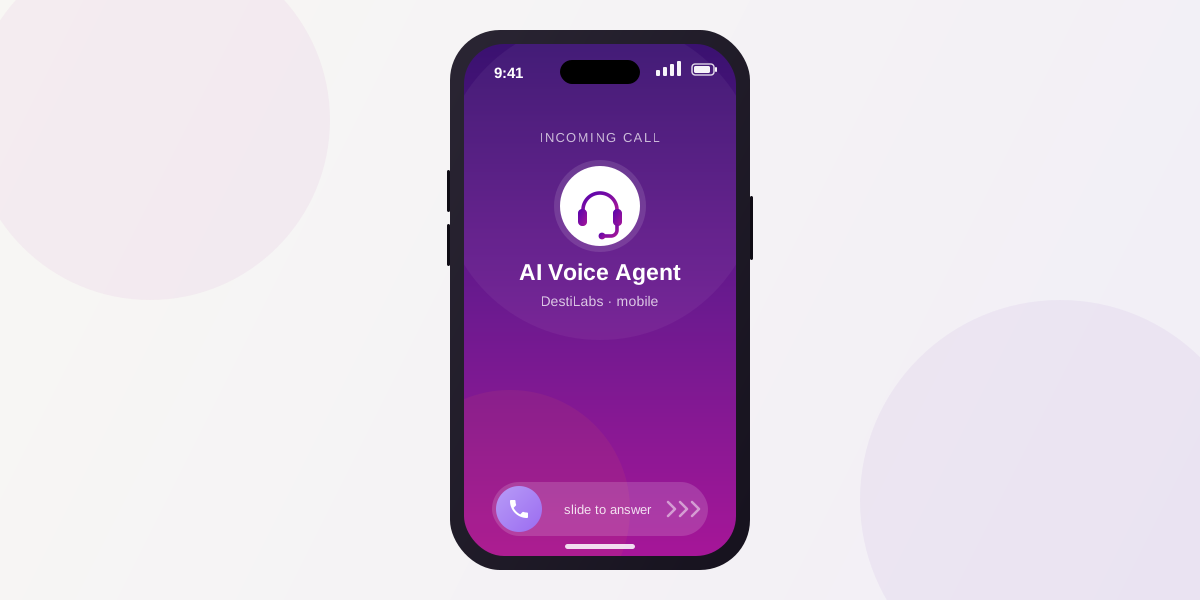
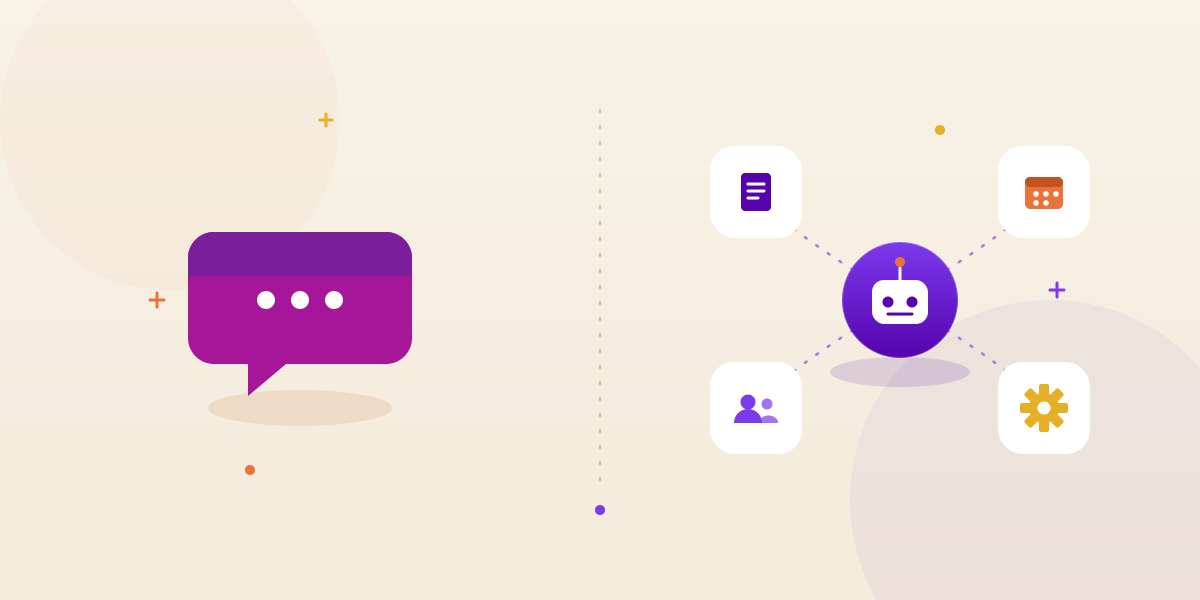
The simplest way to think about it: a chatbot talks, an agent works. And in 2026, these agents don't just live in a chat window — many of them are picking up the phone and talking to your customers in a natural voice, in real time.
Why should a business owner care?
Because most businesses are leaving money on the table in places that are easy to fix.
The phone rings while your front desk is helping someone in person — so it goes unanswered, and that caller books with a competitor. A promising lead fills out a form at 9pm and doesn't hear back until noon the next day, by which point they've cooled off. Your team spends hours on repetitive admin instead of the work that actually grows the business.
AI agents close those gaps. They don't get tired, they don't take lunch, and they don't miss the 14th call of the morning. The result isn't just a leaner operation — it's more revenue captured from demand you already have, and a team freed up to focus on the things only humans can do well.
That's the real shift in 2026: agents have gone from a nice-to-have experiment to a genuine growth lever.
The 9 best AI agent use cases for business in 2026
1. Voice AI agents (answering calls & booking appointments)
What it does: Picks up the phone, talks naturally with the caller, answers their questions, and books or reschedules appointments straight into your calendar. It's available 24/7, never puts anyone on hold, and only hands off to a human when it genuinely needs to. (New to these? Start with what an AI voice agent is and how it works.)
Real example — dental clinics: We built a voice AI agent for dental clinics that handles every single inbound call. Picture a busy front desk: the phone is ringing while a patient is standing at the counter and another is in the chair. Normally, somebody's getting ignored. With the voice agent, every caller is answered warmly, appointments get booked right into the clinic's calendar, common questions (hours, insurance, pricing, directions) are handled instantly, and new-patient details are captured — all without the front desk breaking stride.
What the clinic gets:
- A fuller appointment book. Every call gets answered, including evenings and weekends, so the bookings that used to slip away now turn into patients in chairs.
- More revenue from demand they already had. They're not spending more on marketing — they're finally capturing the calls that marketing was already generating.
- A calmer, happier front desk. Staff stop juggling a ringing phone and can give the patient in front of them their full attention.
- A better first impression. Callers get a friendly, instant response instead of voicemail — and that warm first touch wins more patients.
- Booking that never sleeps. People can schedule at 10pm on a Sunday, exactly when they're thinking about that toothache.
This works beyond dental, too: clinics and healthcare, home services (HVAC, plumbing, electrical), restaurants, real estate, salons and spas — anywhere a ringing phone is really a booking waiting to happen.
2. Document processing & verification agents
What it does: Reads through paperwork — forms, PDFs, scans — pulls out what matters, checks it, and produces a decision you can trust.
Real example: Future Mortgage worked with DestiLabs to automate their mortgage background checks. What used to take over 48 hours now takes minutes, the system handles 80% of the work that used to be manual, and every single decision can be traced back to its source document — which matters enormously in a regulated industry.
What you get:
- A two-day bottleneck becomes minutes. The rest of your pipeline — and your revenue — stops waiting on paperwork.
- 80% less manual work. Skilled staff get pulled off data entry and back onto work that needs judgment.
- Fewer costly errors, full audit trail. Every decision traces back to its source document — essential when you're regulated.
- Capacity to absorb volume spikes. Busy season stops meaning a hiring scramble.
3. Customer support agents
What it does: Handles the routine questions and requests — order status, refunds, account changes — and only loops in a human for the tricky stuff. This is the most common thing businesses ask us to build — see our AI chatbot development services for what a production support agent includes.
What you get:
- Customers stop leaving. They get an answer in seconds at any hour, instead of waiting in a queue and churning to a competitor who replied faster.
- Support stops scaling with headcount. You handle more volume as you grow without adding seats to the queue every quarter.
- Your best people do higher-value work. They focus on the conversations that save accounts and drive upsells, not password resets.
- Repeat business goes up. A fast, helpful answer is one of the cheapest ways to keep a customer buying — and satisfaction scores follow.
4. Finance & accounts payable agents
What it does: Matches invoices to orders, spots anything that looks off, and gets your books ready to close.
Real example: For a fintech client, DestiLabs built an AI CFO agent that reasons over complex financial APIs and reaches CFO-grade conclusions in about five minutes — at roughly 93% precision and under a dollar per query.
What you get:
- A faster month-end close. You make decisions on this month's numbers, not last month's.
- Money stops leaking. Duplicate, inflated, and fraudulent invoices get caught before the payment goes out.
- Better cash position. You capture early-payment discounts and stop racking up late fees.
- CFO-grade answers on demand. Your team gets a defensible read on the numbers in minutes instead of waiting days for analysis.
- A finance team focused on insight. They analyze the business instead of matching invoices to POs.
5. Sales development & lead qualification agents
What it does: Researches new leads, figures out who's a good fit, writes a personalized first message, and books the meeting.
What you get:
- You win the deals that go to whoever replies first. Hot leads get a personalized response in minutes, not hours — while they're still interested.
- Your reps' calendars fill with qualified meetings. They stop spending mornings on research and spend their time closing.
- More of your marketing spend converts. No inbound lead goes cold sitting in an inbox overnight.
- A pipeline you can actually forecast. Steady, qualified flow instead of feast-or-famine months.
6. IT & DevOps agents
What it does: Watches for alerts, diagnoses common issues, and fixes the routine ones before anyone has to get paged.
What you get:
- Less downtime, less lost revenue. Routine incidents get resolved before customers ever notice.
- Faster recovery when things do break. Problems are diagnosed and triaged in seconds, not after someone wakes up.
- Engineers freed to ship product. Time goes to roadmap work instead of firefighting.
- Less burnout and turnover. A quieter on-call rotation keeps your best engineers around.
7. Recruiting & HR agents
What it does: Screens applicants, schedules interviews, answers candidate questions, and smooths out onboarding.
What you get:
- You hire the best people first. Strong candidates get screened and booked before competitors reach them.
- Open roles stop costing you. Faster time-to-hire means less lost productivity from empty seats.
- A brand-safe candidate experience. Every applicant gets a prompt, professional response, win or lose.
- New hires productive sooner. Organized onboarding gets people contributing in days, not weeks.
8. Procurement & supply chain agents
What it does: Keeps an eye on inventory, reorders before you run out, and tracks how suppliers are performing.
What you get:
- Fewer stockouts. You stop losing sales — and customers — to empty shelves.
- Better prices. Timely, data-backed reordering and supplier scorecards strengthen every negotiation.
- Less cash tied up. You avoid over-ordering and the working capital that sits in excess inventory.
- Far less manual chasing. POs, confirmations, and follow-ups handle themselves.
9. Marketing & content operations agents
What it does: Researches topics, drafts content, and adapts it across all your channels.
What you get:
- More output without a bigger team. More posts, campaigns, and experiments from the same headcount.
- Faster time-to-market. Ideas reach every channel in a fraction of the time.
- More winners. More at-bats means more campaigns that land — growth compounds.
- Your best people on strategy. They spend energy on creative and positioning, not formatting and reposting.
Want to turn missed opportunities in your business into revenue? Let's see what AI agents can do for you. → Book a call
What does this actually cost?
Let's be straight about the numbers, because vague answers help no one.
Building an agent is usually a one-time investment of $15K–$150K, depending on how complex the job is and how many systems it needs to connect to. Then there's a monthly running cost — somewhere from a few hundred to a few thousand dollars — to keep it live (for voice agents, that includes the phone minutes). And like any system, it needs a bit of ongoing care and tuning over the year.
To put that in perspective: a voice agent for a clinic or service business typically lands in the $20K–$70K range to build, because it needs to plug into your phone line, your calendar, and your booking system. The more business-critical and regulated the work, the more it sits toward the higher end — that's where the engineering goes into making it bulletproof and fully auditable. (For a deeper breakdown, see our guide on how much it costs to build an AI agent in 2026.)
So what's the actual payoff?
Here's the part that matters most: the best AI agents don't just save you money — they make you money.
A support agent means customers get answers instantly, so they stick around and buy again. A sales agent means hot leads get a reply while they're still interested, so more of them convert. A document agent means a 48-hour bottleneck becomes a few minutes, so your whole pipeline moves faster and you close more deals.
And a voice agent is the clearest example of all. Every call it answers that would otherwise have gone to voicemail is a potential booking — and every booking is real revenue. For a dental clinic, recovering just a handful of those calls a week can pay for the entire system, and everything beyond that is pure upside. You're not cutting your way to savings; you're capturing growth that was quietly walking out the door.
Across the board, most well-chosen projects pay for themselves in 3 to 9 months — and then keep paying you back, month after month, without asking for a raise or a vacation.
Where should you start?
Don't try to automate everything at once. Pick the one job that's high-volume, clearly defined, and genuinely costing you money or customers — and start there.
For a lot of businesses, that first win is a voice agent on your phone line. The demand is already there (your phone is already ringing), the result is easy to measure (calls answered, appointments booked), and the payback comes fast. Get one win on the board, prove the value, and expand from there.
Frequently Asked Questions
What's an AI agent, in simple terms?
It's software that completes whole tasks for you — like booking an appointment or qualifying a lead — instead of just answering a question like a chatbot does.
What's a voice AI agent?
It's an AI that answers your phone and holds a natural conversation with callers — answering questions, booking appointments, and only passing the call to a person when it needs to. It works around the clock and never puts anyone on hold.
Can a voice AI agent really book appointments?
Yes. For example, a voice agent built for dental clinics answers every inbound call, books and reschedules straight into the clinic's calendar, and handles routine patient questions — turning calls that used to be missed into booked appointments.
Which AI agent should a business try first?
Start with the job that's high-volume and costing you customers or money. For many service businesses, that's a voice agent answering inbound calls, because it's easy to measure and pays back quickly.
What's it going to cost?
Most agents cost $15K–$150K to build and a few hundred to a few thousand dollars a month to run. Voice agents usually fall in the $20K–$70K build range.
When will I see a return?
Most well-scoped projects pay for themselves within 3–9 months — and voice agents often pay back even faster, because every recovered call can mean a new booking.
Key Takeaways
- 1An AI agent does whole jobs, not just answers. It books the appointment, qualifies the lead, or clears the invoice end-to-end — a chatbot talks, an agent works.
- 2The best 2026 use cases are high-volume, repetitive work — answering calls, booking appointments, qualifying leads, processing paperwork, chasing invoices.
- 3Voice agents are the fastest win for service businesses. The demand is already on your phone line; every recovered call is a potential booking and real revenue.
- 4Budget $15K–$150K to build (voice agents usually $20K–$70K) plus a few hundred to a few thousand a month to run.
- 5The real payoff is captured revenue, not just savings — most well-scoped projects pay for themselves in 3–9 months, then keep paying back.
- 6Start with one clear, measurable win, prove the ROI, and expand from there.
The bottom line
AI agents in 2026 aren't about replacing your team or chasing a shiny trend. They're about plugging the leaks where you're losing customers and revenue — the unanswered call, the slow reply, the bottleneck that holds everything up — and turning that lost demand into growth.
Whether it's a voice agent that answers every call for a dental clinic and keeps the appointment book full, or a document agent that turns a two-day mortgage check into a two-minute one, the businesses winning right now are the ones treating agents as a practical investment in growth. Start with one clear win, measure it, and build from there.
Want to turn missed opportunities in your business into revenue? Let's see what AI agents can do for you. → Book a call
We build what you're reading about
Custom AI agents, voicebots and chatbots that cut costs, unlock growth, and deliver results you can see.