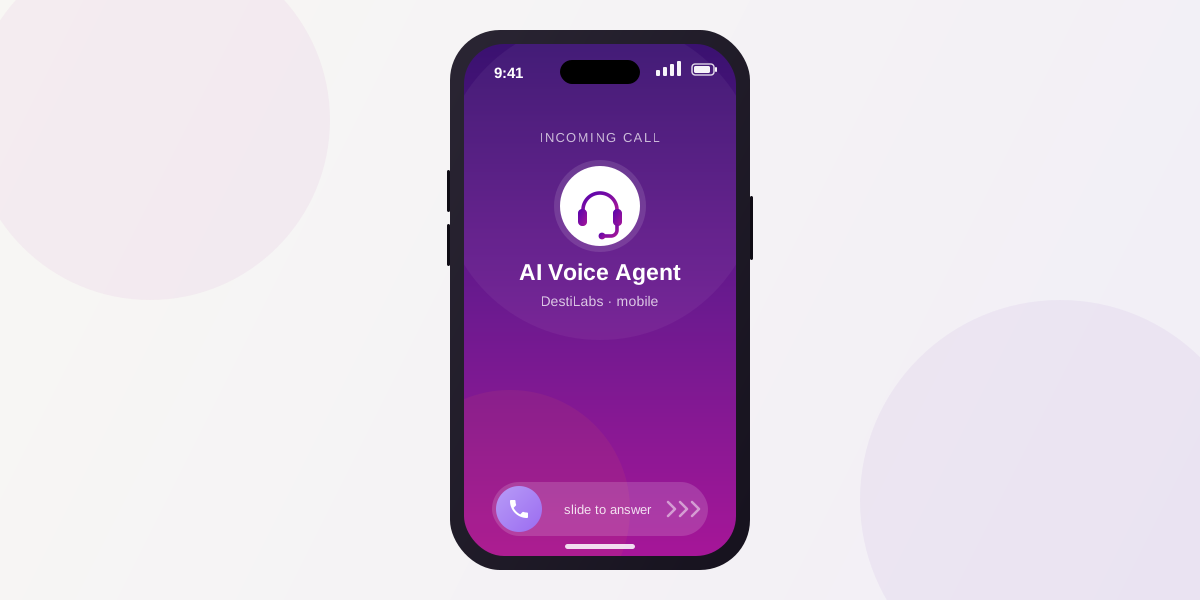
An AI voice agent is software that conducts natural, spoken phone conversations with customers in real time — understanding what callers say, responding in a human-like voice, and completing tasks like answering questions, booking appointments, qualifying leads, or processing refunds without a human on the line.
Unlike the old "press 1 for billing" phone menus (IVR), a modern AI voice agent lets people speak naturally and gets the job done in one call. It listens, understands intent, pulls answers from your systems, takes action, and knows when to escalate to a human.
If your team is drowning in repetitive calls — appointment scheduling, order status, FAQs, after-hours inquiries — an AI voice agent handles that volume around the clock, so your people can focus on the conversations that actually need them.
Want to see what an AI voice agent would sound like for your business? Book a free 30-minute call with the DestiLabs founders — no pitch, just an honest read on whether it's the right move. → Book a call
How Does an AI Voice Agent Work?
An AI voice agent strings together four steps in under a second, on a loop, for the entire call:
- 1Speech-to-text (STT): The caller speaks, and the agent transcribes their words in real time.
- 2Language understanding (LLM): A large language model interprets intent, remembers context from earlier in the call, and decides what to do — answer, ask a follow-up, or take an action.
- 3Action & retrieval: The agent looks up real answers from your knowledge base, CRM, or booking system (this is where retrieval-augmented generation, or RAG, keeps responses accurate) and executes tasks like creating a booking or issuing a refund.
- 4Text-to-speech (TTS): It replies in a natural, human-sounding voice — and the loop repeats.
The result is a conversation that feels human, runs 24/7, handles thousands of calls at once, and never puts a caller on hold. (Curious which underlying platform sounds best? We graded eight of them in our voice bot platforms benchmark.)
AI Voice Agent vs. Chatbot vs. IVR: What's the Difference?
A quick reference for the most common question buyers ask:
- IVR (phone menu): Rigid, menu-driven ("press 1…"). Cheap but frustrating, and it can't actually resolve much.
- Chatbot: Text-based, lives on your website or WhatsApp. Great for typed questions, but not for phone callers.
- AI voice agent: Speaks and listens like a person, handles open-ended phone conversations, and completes tasks end to end. It's the voice-native evolution of both.
If most of your customer demand comes through the phone, a voice agent is what closes the gap that chatbots and IVR leave open.
What Can an AI Voice Agent Actually Do? (Core Use Cases)
A well-built AI voice agent goes far beyond answering FAQs. Common jobs include:
- Inbound call handling: Answer every call instantly, 24/7, with zero hold time.
- Appointment booking & rescheduling: Check availability and write directly to your calendar.
- Lead qualification: Greet inbound leads, ask qualifying questions, and route hot prospects to sales.
- Outbound calls: Appointment reminders, payment follow-ups, and re-engagement campaigns.
- Customer support & resolution: Order status, account questions, and common issues — resolved on the call.
- After-hours coverage: Capture and serve demand when your team is offline.
- Smart escalation: Hand off to a human with full context the moment a call needs it.
For a wider look at where these agents pay off, see our roundup of AI agent use cases for business.
Curious which of these would move the needle for your team? Talk to a founder — we'll map it to your real KPIs before you commit to anything. → Book a call
AI Voice Agents by Industry
The highest ROI comes when a voice agent is tailored to your industry's workflows. Here's how different teams use them:
Healthcare
Patient appointment scheduling, prescription refill requests, intake and pre-screening, and after-hours triage routing — reducing front-desk load while keeping patients served. (Built with the privacy and compliance guardrails healthcare requires.) We go deep on this in our guide to the AI receptionist for healthcare, and you can see the full picture of AI for healthcare.
Banking & Financial Services
Balance and transaction inquiries, card activation, fraud-alert confirmations, and payment reminders — handled securely, with sensitive actions escalated appropriately. See how we approach AI agents for fintech with auditable, regulator-ready precision.
Real Estate
Instant response to inbound buyer and renter inquiries, lead qualification, and viewing bookings — so no lead goes cold while an agent is showing a property. More on AI voicebots for real estate.
Dental & Local Clinics
Front-desk automation: booking, reminders, and answering "are you open / do you take my insurance" calls that otherwise interrupt staff all day.
Call Centers & Customer Service
Deflect high-volume repetitive calls, cut average wait times to zero, and let human agents focus on complex, high-value conversations.
Restaurants & Hospitality
Reservations, takeout orders, and FAQ calls handled during the dinner rush without tying up staff.
Small & Service Businesses
A 24/7 receptionist that never misses a call — capturing booking and revenue you'd otherwise lose to voicemail.
Don't see your industry? DestiLabs builds custom AI voice agents for fintech, healthcare, retail, real estate, and transportation teams. Book a call and we'll tell you straight whether it fits. → Book a call
How Much Does an AI Voice Agent Cost?
Costs depend on call volume, complexity, integrations, and whether you use an off-the-shelf platform or a custom-built agent. There are generally three approaches:
- DIY platforms: Lowest upfront cost, usage-based per-minute pricing, but limited to what the platform supports — and you do the building and maintenance.
- Custom-built agents: Higher initial investment, but built around your exact workflows, integrated with your stack, and owned by you — the option that "pays for itself" when call volume is meaningful.
- Hybrid: Start with a focused use case, prove ROI, then scale.
The right question isn't "what's the cheapest tool" — it's "how much is each missed or mishandled call costing me today?" Most teams find the agent pays back quickly once you count recovered bookings, faster resolution, and freed-up staff time. For a deeper breakdown, read our guide to AI agent development cost.
Want a straight answer on cost and payback for your situation? Book a free call — we'll give you an honest read, no SDR, no pitch. → Book a call
How to Build (or Deploy) an AI Voice Agent
A reliable production voice agent follows a clear path:
- 1Discovery: Map your call types, workflows, and the systems it needs to connect to.
- 2Prototype: Build a working agent for your top use case (DestiLabs ships a working prototype in the first 5 days).
- 3Integrate & harden: Connect your calendar, CRM, and knowledge base, and handle edge cases reliably.
- 4Polish & monitor: Add real-time tracking, alerts, and a status page for full transparency.
- 5Support & improve: Tune the agent against live calls — because the best agents get better over time.
You can stitch this together yourself with platforms — or have a team that's shipped 50+ AI projects do it with you.
Skip the trial-and-error. Talk to the DestiLabs founders about building a voice agent that's production-ready, not a demo. → Book a call
Frequently Asked Questions
What is an AI voice agent?
An AI voice agent is software that holds natural, spoken phone conversations in real time — understanding callers, answering in a human-like voice, and completing tasks like booking appointments or resolving support issues, with escalation to a human when needed.
How does an AI voice agent work?
It converts speech to text, uses a large language model to understand intent and decide what to do, retrieves accurate answers and takes actions in your systems, then replies in a natural voice — repeating this loop throughout the call.
What do AI voice agents do?
They answer inbound calls 24/7, book and reschedule appointments, qualify leads, make outbound reminder and follow-up calls, resolve common support requests, and route complex calls to human staff. For a deeper look at how AI voice agents work and where to use them, see our buyer's guide.
How much does an AI voice agent cost?
It varies by call volume, complexity, and whether you use a platform or a custom build. The most useful benchmark is comparing it to the cost of your missed, delayed, or mishandled calls today — which is where the payback usually comes from.
Is an AI voice agent better than a chatbot?
They solve different channels. Chatbots handle typed website/WhatsApp conversations; voice agents handle phone calls. If most of your customer demand is by phone, a voice agent fills the gap a chatbot can't.
Ready to Put an AI Voice Agent to Work?
An AI voice agent turns your phone line into a 24/7 revenue and service engine — answering instantly, booking automatically, and never missing a call. The teams that win are the ones that build it around their actual workflows, not a generic demo.
DestiLabs builds custom AI voice agents and chatbots that pay for themselves. Book a free 30-minute call with our founders — no pitch, no SDR, just an honest read on whether an AI voice agent is right for your business.
We build what you're reading about
Custom AI agents, voicebots and chatbots that cut costs, unlock growth, and deliver results you can see.