TL;DR
An AI answering service answers every inbound call the instant it rings, 24/7, and takes action — booking appointments, qualifying leads, routing urgent calls, answering routine questions — instead of just recording a message. Usage costs $0.12–$0.15 per connected minute, well under the $1–$2 per minute a staffed human service bills, and managed AI plans run $300–$1,500 a month against $50–$500 for shallow SaaS tools. Run the numbers on a typical service business and cost per captured lead lands in single digits, against jobs worth ten to fifty times that. This guide covers how it works, what it handles, real 2026 pricing, and how to choose a build for your call volume.
The outcomes businesses are leveraging this for are measurable. Roughly 60% of small businesses still send unanswered calls to voicemail, and around 85% of callers who reach voicemail never call back — so every missed call is effectively a lost customer. In deployments we model, switching from voicemail-and-callback to an always-on AI answering service typically recovers 20–30% of previously missed calls, drops average pickup time from minutes to under two seconds, and holds answer rates near 100% around the clock, including the roughly one-in-three calls that arrive after hours. Because speed-to-lead is one of the strongest predictors of conversion — leads contacted within a minute convert several times more often than those left waiting — that swing from missed-and-cold to instantly-answered is where most of the ROI shows up.
Still routing after-hours calls to voicemail? Book a free 30-minute call with DestiLabs — top-ranked AI development studio on Clutch. → Book a call
What is an AI answering service and how does it work?
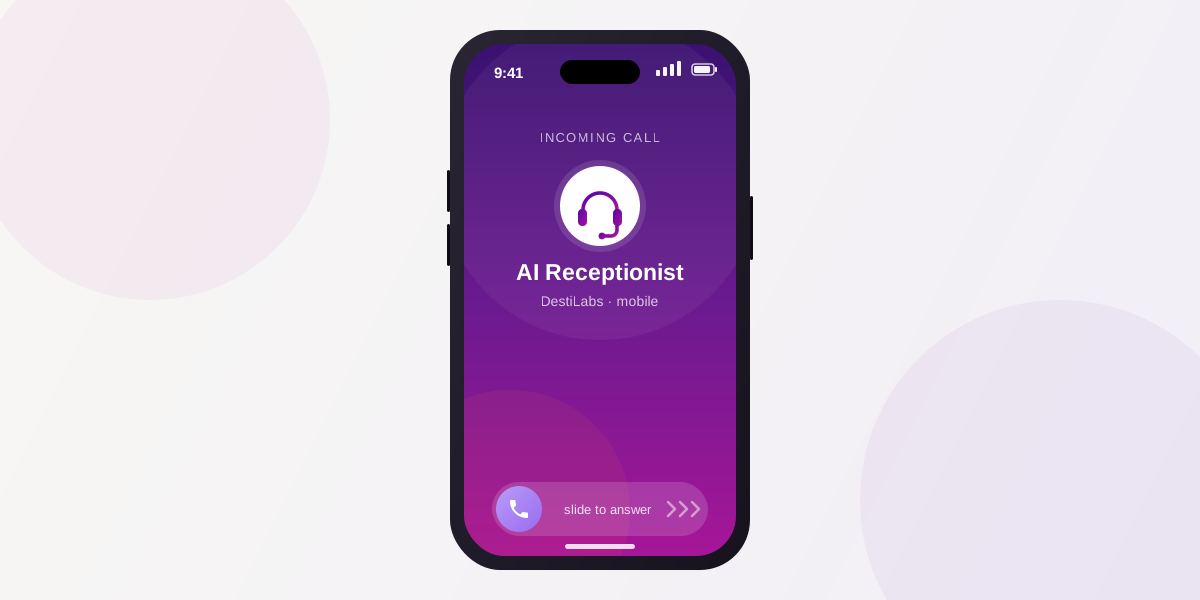
An AI answering service is a voice AI agent that sits on your business phone line, picks up in natural speech, and handles the call the way a sharp front-desk employee would — not the way a voicemail box or a static IVR menu does. It listens to what the caller actually says, works out intent, and either resolves the call itself or hands it off with full context.
Under the hood, three things happen on every call. Speech comes in and gets transcribed in real time; a language model interprets intent and decides what to do — check a calendar, pull an FAQ answer, flag urgency — calling out to your actual business systems mid-conversation; and a voice model speaks the response back, ideally under about 1.2 seconds of latency so the exchange feels like a real conversation, not a laggy bot. Our breakdown of how AI voice agents work covers the mechanics in more depth.
The category goes by several names depending on which angle a vendor is selling — AI phone answering service, 24/7 AI answering service, AI virtual receptionist, AI call answering — but it's the same underlying system. The "answering service" framing emphasizes picking up every call; the "receptionist" framing (see our AI virtual receptionist guide) emphasizes front-desk tasks like routing and scheduling. In practice, one build does both.
What does an AI answering service actually handle?
The job breaks down into five things that eat staff time without needing human judgment, plus one escalation path for everything else:
- Answering every inbound call on the first ring — no overflow to voicemail, no hold queue during a rush
- Qualifying leads by asking the right follow-up questions — budget, timeline, job type, urgency — instead of taking a bare name and number
- Booking and rescheduling appointments against live calendar availability, confirming the slot before the caller hangs up
- Routing calls to the right person, department, or on-call staff member based on what the caller needs
- Capturing structured lead data straight into a CRM, complete with call summary and next action
- Escalating anything outside its scope — a complaint, a legal question, a genuinely upset caller — to a person, with the context already gathered so nobody repeats themselves
Four scenarios where this plays out daily:
An HVAC company gets an AC failure call at 9 p.m. in July. The service picks up instantly, confirms the address and symptoms, flags it urgent, and texts the on-call technician while the caller is still on the line. See AI receptionist for HVAC.
A general contractor runs ads that drive calls all day. Every call that hits voicemail is a lead who calls the next name on the results page instead. The service answers immediately, asks the qualifying questions a job estimator would, and books a site visit — the same pattern we detail for AI receptionist for HVAC.
A small law firm takes intake calls from people in a moment of crisis, at all hours. It answers on the first ring, captures the essentials calmly, and routes anything urgent to an attorney's cell.
A busy restaurant gets a wave of reservation and takeout calls at 6 p.m. while the host stand is slammed. The service takes the reservation, answers "are you open Sundays," and only interrupts staff for what a script can't handle.
AI answering service vs. a human answering service: how do they actually compare?
The comparison isn't close on most dimensions, and the gap widens as call volume grows.
| Dimension | Human answering service | AI answering service |
|---|---|---|
| Availability | Staffed hours only; overnight and weekend coverage costs a premium or isn't offered | True 24/7, same quality at 3 a.m. as 3 p.m. |
| Answer rate | Typically 70–85% during staffed hours; queues and hold time during spikes | Effectively 100% — every call answered instantly, no queue |
| Consistency | Varies by agent, shift, and mood; scripts drift over time | Same greeting, same accuracy, same information on every call |
| Cost structure | $1–$2 per minute, or $1.50–$3 per call, plus a monthly base fee | Flat $0.12–$0.15 per connected minute, no per-call markup |
| Integrations | Usually message-only; booking needs a live warm transfer | Connects directly to your calendar, CRM, and scheduling system |
| Scale | More volume means more staffed seats and more scheduling headaches | One agent scales to any call volume at the same per-minute rate |
Instant pickup is the most visible gap. A caller who hits hold music or voicemail is deciding, in real time, whether to wait or call the next business on the list. An AI answering service never puts anyone in that position — it answers the first ring whether that's call one of the day or call fifty stacked at once.
Cost compounds at scale, too. Human per-minute pricing carries a built-in labor markup that doesn't shrink as volume grows — more calls means more billed minutes, often with after-hours surcharges. AI usage cost stays flat per minute regardless of call count, so unit economics improve rather than degrade as your phone gets busier.
Where a person still wins is judgment on hard calls — a distressed customer, a complex complaint, a conversation that needs empathy over a script. That's why the strongest setups aren't all-or-nothing: AI handles the routine majority instantly, and a person picks up the rare sensitive call with context already captured.
Curious what your current missed-call rate is actually costing you? Book a free 30-minute call with DestiLabs — top-ranked AI development studio on Clutch. → Book a call
How much does an AI answering service cost in 2026?
Pricing splits into three usage models, plus what a custom build costs if you go that route. Knowing which one you're being quoted matters more than the headline number.
Per-minute pricing bills for actual talk time — typically $0.12–$0.15 per connected minute in real deployments. It rewards short, efficient calls and scales predictably: 2,000 connected minutes a month lands around $240–$300, regardless of how those minutes spread across the day. Watch for vendors quoting a "platform" rate that excludes telephony or model costs — the all-in per-minute number is the one that matters.
Per-call pricing bills a flat fee per answered call, usually $0.50–$1.50 for SaaS tools, regardless of length. It favors longer calls and is easier to budget against monthly volume, but it overcharges for short, simple calls a per-minute model would price fairly.
Flat monthly pricing bundles a set volume of minutes or calls into a fixed fee, with overage past the cap. Off-the-shelf SaaS tools run $50–$500 a month at this tier but tend to be shallow — generic scripts, thin integrations. Managed AI plans with real calendar and CRM integration typically run $300–$1,500 a month.
Custom build economics look different: a one-time build cost plus a low ongoing run rate. A custom AI answering service wired into your scheduling software, CRM, and phone system runs $35,000–$150,000 depending on integration count, with a scoped proof-of-concept from about $8,000–$25,000 to validate latency, accuracy, and ROI first. Our AI voice agent pricing breakdown covers every cost driver, and custom AI agent development scoped to one workflow is the fastest path to the lower end of that range.
Whatever model you're quoted, judge it on all-in cost per connected minute or per captured lead — not the sticker price on the plan.
What's the actual ROI — cost per captured lead vs. cost of a missed call?
Run the math on a service business fielding 500 inbound calls a month. A human service, staffed during business hours only, typically misses around a fifth of that volume to after-hours gaps, hold-queue abandonment, and overflow — call it 100 calls a month that hit voicemail or ring out unanswered.
An AI answering service captures those 100 calls. At an average call length of 4 minutes and $0.13 per connected minute, that's about $52 in usage cost. Add a managed plan fee of roughly $400 a month, and the all-in cost for those 100 extra captured calls runs around $452 — call it $4.50 per captured lead.
Weigh that against what a missed call costs. If even a quarter of those 100 recovered calls convert into a booked job worth $350 on average, that's 25 jobs worth $8,750 against $452 to capture the leads that made it possible. Even discounting for calls that would never have converted, cost per captured lead sits far below the value of a single closed job in nearly every trades, clinic, legal, or hospitality scenario we've modeled. Plug in your own call volume, job value, and close rate with the AI agent ROI calculator to see your payback period.
How do you choose and deploy an AI answering service?
Score any candidate on five things, roughly in this order of importance:
- 1Measured latency and real cost per connected minute — ask for numbers, not a demo clip. Above about 1.2 seconds of response time, calls start feeling robotic.
- 2Depth of integration with your actual calendar, scheduling software, and CRM — not a generic webhook that half-works and needs a human to finish the job anyway.
- 3Escalation quality — does it recognize when a call is outside its scope and hand off cleanly with context, or does it loop the caller through the same three questions?
- 4Coverage across locations and lines — one agent should answer correctly for every location, not require a separate setup per site.
- 5Build path — a rigid off-the-shelf SaaS product, or a build tuned to how your business actually books, routes, and escalates calls?
Deployment is usually faster than people expect once the workflow is scoped: connect the number, wire up the calendar and CRM, script the escalation rules, and pilot on a slice of call volume before flipping the whole line over. A provider who answers with hard numbers on latency, accuracy, and cost is a safer bet than one who answers with adjectives. If you're weighing a template SaaS tool against a scoped custom build, our guide to build vs. buy for custom AI agent development walks through where that line sits.
Which businesses get the fastest payback from an AI answering service?
The fastest returns land with businesses that live on the phone and lose real money every time a call goes unanswered:
- Home services — HVAC, plumbing, electrical, general contracting — where after-hours emergency calls are high-value and time-sensitive.
- Small businesses generally, where a single owner or small front desk can't realistically staff every hour the phone might ring.
- Legal, medical, and dental practices, where intake and scheduling calls are constant and every unanswered call is a person who may simply call the next name on the list.
- Restaurants and hospitality, where reservation and order calls spike exactly when staff are busiest on the floor.
What they share: high call volume, repetitive booking-and-routing questions, and staff who can't always pick up the phone the instant it rings. Across every one of those verticals, the math is the same shape — usage cost measured in cents per minute, weighed against jobs, patients, or reservations worth hundreds or thousands of dollars each.
Ready to see what an AI answering service would look like for your call volume? Book a free 30-minute call with DestiLabs — top-ranked AI development studio on Clutch. → Book a call
Frequently Asked Questions
What is an AI answering service?
It is a voice AI agent that answers your business phone in natural speech, understands what the caller needs, and takes action — booking, routing, capturing a lead — instead of just recording a message. It answers every call the instant it rings, 24/7, and escalates anything outside its scope to a person.
How much does an AI answering service cost in 2026?
Usage runs $0.12–$0.15 per connected minute in typical deployments. Off-the-shelf SaaS tools run $50–$500 a month with limited depth, managed plans with real integrations run $300–$1,500 a month, and a custom build wired into your calendar, CRM, and phone system runs $35,000–$150,000, with a proof-of-concept from about $8,000.
Is an AI answering service better than a human answering service?
For volume and availability, yes — it answers essentially 100% of calls instantly at a flat per-minute rate, where a staffed human service typically answers 70–85% of calls during business hours and bills $1–$2 per minute or $1.50–$3 per call. A human still wins on genuinely sensitive, emotionally charged conversations.
What's the difference between an AI answering service and an AI virtual receptionist?
They're largely the same technology described from two angles — an answering service framing emphasizes picking up every call and acting on it, while a virtual receptionist framing emphasizes front-desk tasks like routing and scheduling. Most vendors, DestiLabs included, build one system that does both.
Can an AI phone answering service book appointments, not just take messages?
Yes, a properly built one connects to your live calendar or scheduling software to check availability, book or reschedule, and text a confirmation before the call ends. A basic call-forwarding or message-taking service only records a name and number for callback.
Does a 24/7 AI answering service really work overnight and on weekends?
Yes. It answers at 3 a.m. on a Sunday with the same accuracy as 3 p.m. on a Tuesday, which matters because a meaningful share of booking and emergency calls arrive when a staffed office is closed and would otherwise go to voicemail.
Key Takeaways
- An AI answering service answers every call instantly, 24/7, and takes action — booking, qualifying, routing, capturing leads — not just recording messages for callback.
- It beats a human answering service on availability, answer rate, cost, and scale; humans still win on genuinely sensitive, emotionally charged calls.
- Usage runs $0.12–$0.15 per connected minute, managed plans run $300–$1,500 a month, and custom builds run $35,000–$150,000 with a proof-of-concept from about $8,000.
- Cost per captured lead typically lands in single digits against jobs or bookings worth ten to fifty times that — run your own numbers with the ROI calculator.
- Home services, small businesses, legal and medical practices, and hospitality see the fastest payback because a missed call there is a lost customer, not just a lost message.
- The right choice depends on call volume and integration depth — high volume with deep integration needs favor a custom build over off-the-shelf SaaS.
Ready to stop losing calls to voicemail? Book a call with DestiLabs and get real numbers for your call volume.
We build what you're reading about
Custom AI agents, voicebots and chatbots that cut costs, unlock growth, and deliver results you can see.