
AI voice agents we build
Inbound AI receptionists
Every call answered on the first ring, 24/7. The agent answers questions, takes messages and routes urgent calls, so nothing goes to voicemail after hours.
Appointment booking & rescheduling
Bookings, cancellations and reschedules written straight into your calendar or practice system, with confirmations sent by SMS. No callbacks, no double-booking.
Customer support voice agents
Order status, returns, balances, refills and account changes resolved on the call. In production we see 79–88% of these calls handled with no human.
Outbound reminder & follow-up calls
Appointment reminders, payment reminders, driver check-ins and post-visit follow-ups made at scale, with every outcome logged back to your CRM.
IVR replacement
The "press 1 for billing" menu replaced by an agent that understands what the caller wants and either solves it or routes it to the right person in seconds.
Multilingual voice agents
One agent that detects the caller's language and answers in it, so you can serve new markets without hiring a bilingual night shift.
AI voice agent case studies
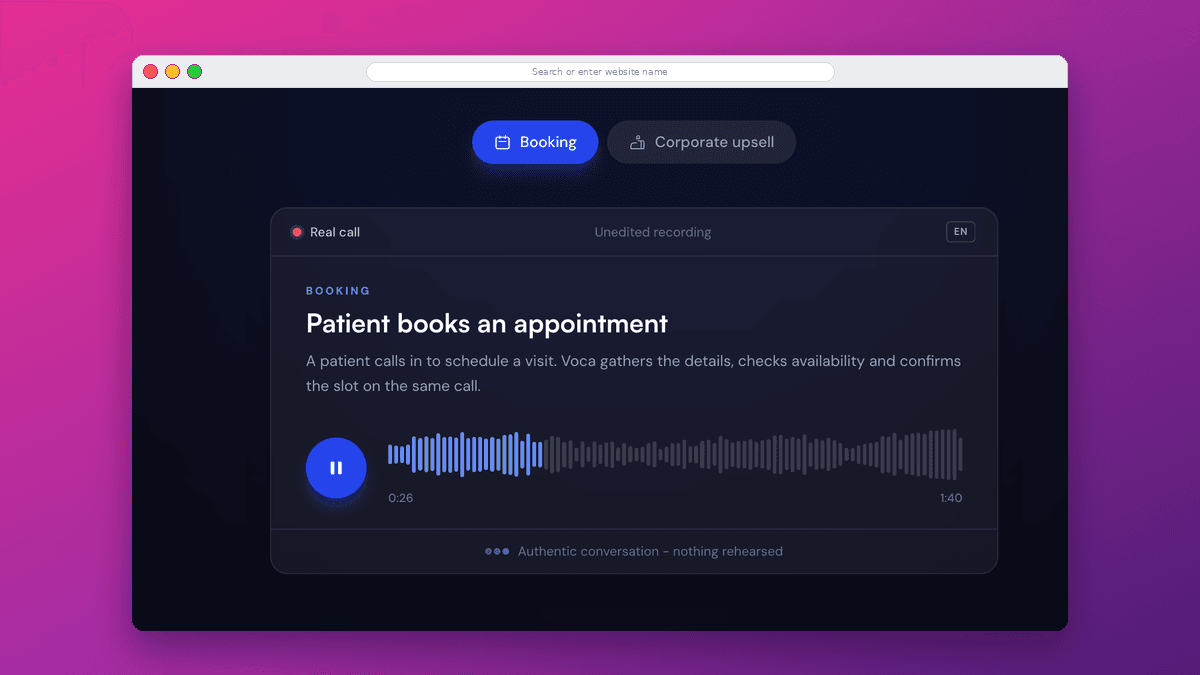
A low-latency voice agent platform on open-source speech-to-text, LLM and text-to-speech models, running at 0.99–1.3s p95 latency and about $0.12 per minute across 4 continents, without vendor lock-in.
Read full case study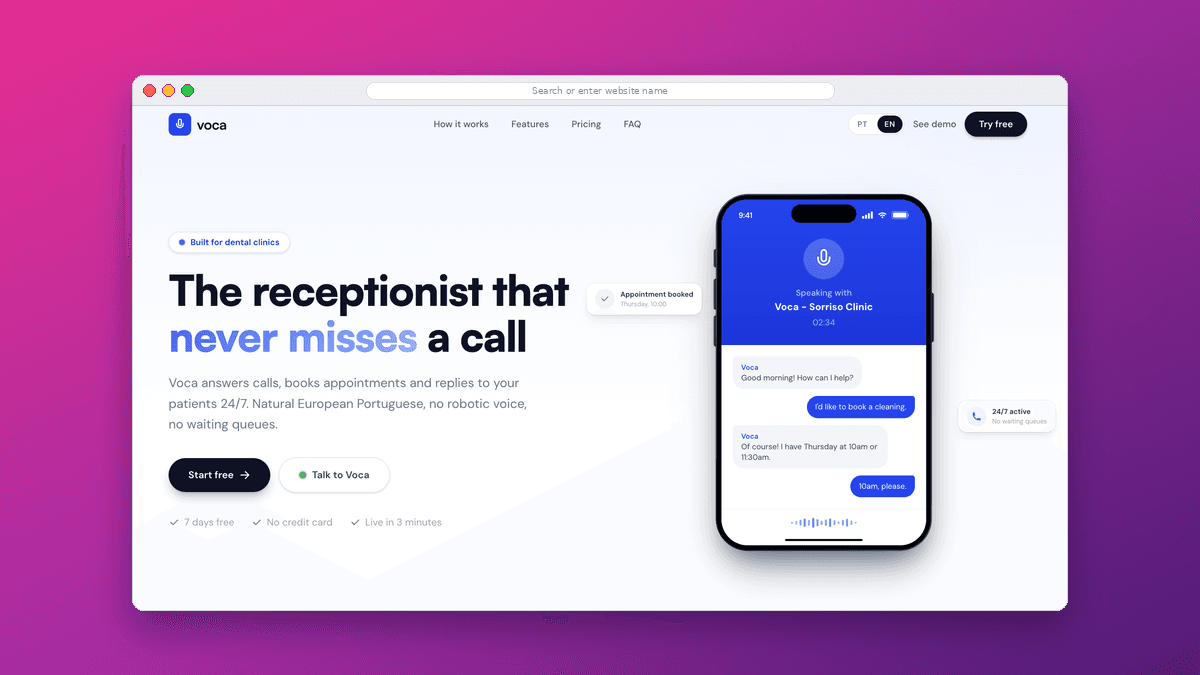
Voca, one voice agent product that many small businesses configure themselves for booking and information calls, at 0.99–1.2s latency and under $0.15 per minute.
Read full case studyHow our AI voice agent development process works
Days 1–5: a call you can make
We pick your highest-volume call type, connect a sample of your data and give you a phone number to call a working agent, before you commit to a build.
Weeks 2–8: proof of concept
The agent takes real calls. You get measured latency, cost per minute and containment, an integration plan and a production budget.
Production, then every week after
Two-week sprints connect telephony, CRM and calendar. After launch we review failed calls weekly and fix them, so containment keeps rising.
Why teams choose us as their AI voice agent company
- Latency you can measure: a 680 ms median across our 2026 deployments, so callers don't talk over the agent.
- Platform-agnostic builds: Retell, Vapi, ElevenLabs, OpenAI Realtime, or a custom open-source stack, chosen for your cost and latency targets, not a reseller deal.
- Cost per minute you can forecast: we design to a target per-minute cost, from $0.07 on high-volume cascaded stacks.
- Full ownership: code, prompts, call flows and documentation are yours. No per-seat subscription, no vendor lock-in.
- Compliance built in: call recording consent, AI disclosure and PII redaction designed into every call flow.
- Top-ranked on Clutch for Voice & Speech Recognition.
Industries we've shipped in
AI voice agent guides by industry
Engagements that fit the stage you're in
Discovery call
We rank your call types by ROI and give you a build range and a per-minute estimate for the highest-value one.
Ideal for:
- A business with real inbound or outbound call volume
- Teams comparing voice AI platforms and agencies
- Leaders who need a costed plan before committing budget
Voice agent PoC
A working voice agent on your highest-volume call type, taking real calls, with a callable demo in the first 5 days.
Ideal for:
- You want calls answered by AI but need proof on your traffic first
- An off-the-shelf voice bot sounded robotic or broke on real calls
- You need latency, cost and containment numbers to approve the build
Deliverables:
- Working voice agent on your phone line
- Callable demo within 5 days
- Measured latency, cost per minute and containment
- Telephony and integration plan
- Production scope and budget you can take anywhere
Frequently asked questions
An AI voice agent is software that holds natural phone conversations on its own. It uses speech-to-text to hear the caller, a large language model to decide what to say and do, and text-to-speech to reply, while calling your systems to book, update or look things up. Our guide, What Is an AI Voice Agent?, covers how they work and where businesses use them.
A scoped proof of concept on your highest-volume call type costs $8,000–$25,000. A full custom voice agent is typically $35,000–$150,000+, depending on integrations and call types. Running cost is $0.07–$0.21 per connected minute all-in (telephony, speech-to-text, LLM and text-to-speech). The full breakdown is in AI Voice Agent Pricing in 2026.
Pick one high-volume call type, then connect four parts: telephony (a phone number via SIP, Twilio or Telnyx), streaming speech-to-text, an LLM with tools that can act in your CRM or calendar, and text-to-speech. Test it on real calls, measure latency, cost per minute and containment, and fix failed calls weekly. Standing it up is quick; getting it to production quality is the real work. Want to hear a production agent first? Try Voxletic, our live voice agent.
There is no single best AI voice agent; the right one depends on your call type, volume and integrations. Judge options on four numbers measured on your own calls: p50 latency under 800 ms, all-in cost per connected minute, containment rate (calls resolved without a human) and how deeply it can act in your systems. Hosted platforms win on speed to launch; custom builds win on cost at volume, compliance and control.
You can call a working agent on your data within 5 days. A validated proof of concept takes 4–8 weeks, and production rollout usually follows in a few two-week sprints, depending on telephony and integrations.
Aim for under 800 ms at p50 and under about 1,400 ms at p95, measured from when the caller stops speaking to when the agent starts replying. Above roughly 1,200 ms, callers start talking over the agent. Our 2026 deployments ran at a 680 ms p50 median; full latency, cost and containment results for all 12 projects are in our 2026 AI Voice Agent Benchmark.
Platforms are fastest to start and fine for simple call flows. A custom build pays off when you need deep integrations, strict compliance, a lower cost per minute at volume, or no vendor lock-in. We build on platforms or on our own open-source stack, whichever hits your targets. Our build vs buy guide walks through the decision.
Yes, for inbound calls and for outbound calls made with proper consent. In the US, the FCC ruled in 2024 that AI-generated voices count as "artificial" under the TCPA, so outbound calls need prior express consent. Best practice everywhere is to disclose that the caller is speaking with an AI and to get consent before recording. We build these into the call flow.
Yes. We connect to your existing numbers through SIP or providers like Twilio and Telnyx, and to the systems the agent needs to act in: Salesforce, HubSpot, Google and Outlook calendars, practice management and EHR systems, helpdesks, and your internal APIs. When a call needs a human, it's transferred with a summary so the caller never repeats themselves.
Let's scope your voice agent
Book a 30-minute call. We'll pick your highest-volume call type and tell you honestly what a voice agent would cost and save.