TL;DR: AI agents in healthcare automate high-volume administrative and patient-facing work — scheduling, intake, reminders, triage, and voice calls — inside strict compliance guardrails. They run 24/7, cut staff workload, and shorten patient wait times. A DestiLabs patient-booking agent cut support inquiries by 67%. Custom healthcare AI builds typically run $8,000 for a proof-of-concept to $350,000+ for a production system, with most mid-market projects at $40,000–$120,000. Compliance (HIPAA/data residency) and accuracy must be engineered in from day one.
Want to know which workflow to automate first? Book a free 30-minute call with the DestiLabs founders — no pitch, just an honest read on whether an AI agent fits your practice. → Book a call
What is an AI agent in healthcare?
An AI agent in healthcare is a software system that autonomously handles a defined task — booking appointments, collecting intake information, answering patient questions, or triaging requests — while operating inside compliance and safety guardrails. Unlike a basic chatbot, an agent can take actions: check availability, update records, send reminders, and escalate to a human when needed.
The defining feature is autonomy within boundaries. A healthcare AI agent connects to the systems where work happens — scheduling software, EHR, phone lines — and completes whole workflows rather than just answering questions. Critically, it knows its limits: anything clinical or high-stakes is routed to qualified staff. (For the bigger picture, see our overview of AI for healthcare.)
In 2026, the highest-value healthcare agents target administrative burden, not diagnosis. Scheduling, intake, billing questions, and follow-up reminders consume enormous staff time and are where automation safely delivers the fastest return.
What can AI agents do in healthcare?
Healthcare AI agents handle the repetitive, high-volume work that overwhelms front-desk and support teams. Each use case maps to a measurable reduction in staff workload or patient wait time.
The core use cases are appointment scheduling and rescheduling, patient intake and form collection, appointment reminders and no-show reduction, answering routine questions (hours, directions, prep instructions, billing), prescription refill requests, and triage routing that directs patients to the right resource. A DestiLabs patient-booking agent cut support inquiries by 67% while operating around the clock — see our patient scheduling and intake automation guide and the Odycy case study for a live deployment.
What these share is a clear boundary: the agent owns the administrative layer and hands anything clinical to humans. That separation is what makes healthcare automation both safe and high-ROI.
Why start with scheduling and intake?
Scheduling and intake are the highest-volume, highest-friction tasks in most practices. Automating them frees staff for patient care and removes the phone-tag that frustrates patients. This is almost always the right first agent to build.
How do AI agents cut no-shows?
No-shows cost practices real revenue. An agent that sends smart, timed reminders and offers easy rescheduling recovers slots that would otherwise go empty, paying for itself quickly.
What is an AI voice agent for healthcare?
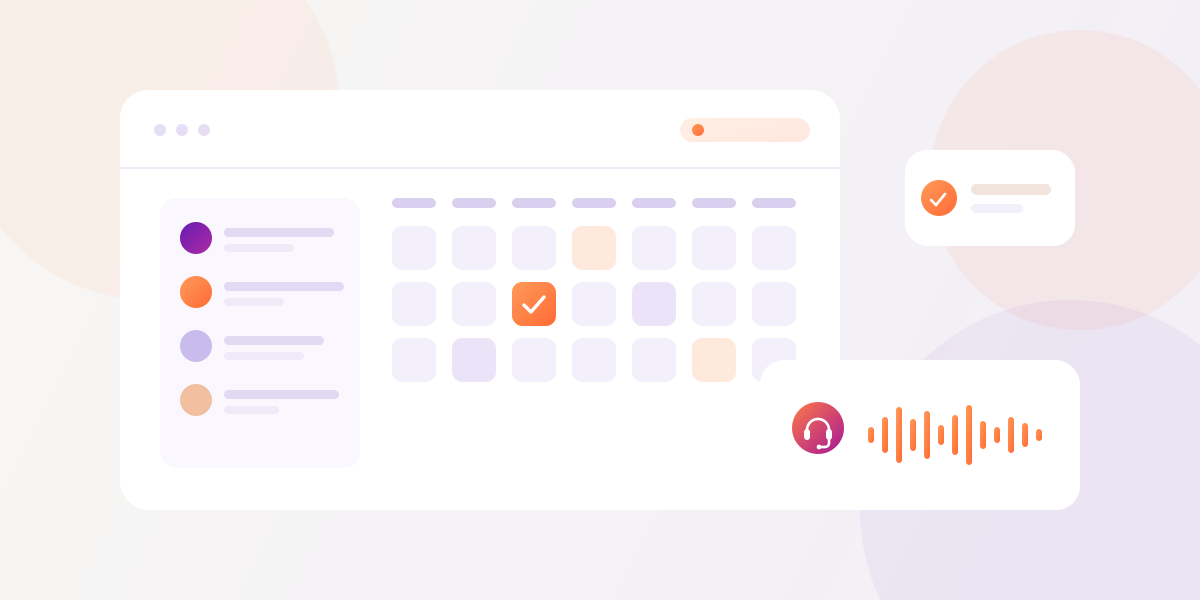
An AI voice agent for healthcare handles inbound and outbound phone calls — scheduling, reminders, and routine questions — using natural speech, so patients who prefer calling get instant service instead of hold music. It's the same agent logic applied to the voice channel, which still dominates healthcare communication.
The hard part of voice is latency and reliability. A voice agent that pauses awkwardly feels broken; patients hang up. DestiLabs voice deployments operate at sub-1.2-second latency (0.99–1.2s) and $0.12–$0.15 per minute, fast and cheap enough to handle real call volume. For the fundamentals, see what is an AI voice agent.
Voice agents are especially valuable in healthcare because they reach patients who don't use portals or apps — older patients, those with limited digital access — while still escalating cleanly to a human for anything sensitive or clinical.
How do AI agents stay HIPAA-compliant?
Compliance is engineered into a healthcare AI agent from the first line of code — it can't be bolted on later. The foundation is controlling where protected health information (PHI) lives and who can access it, keeping data inside compliant infrastructure rather than routing it through consumer tools.
A compliant build covers several layers: PHI stays within HIPAA-eligible environments with signed business associate agreements, data is encrypted in transit and at rest, access is logged and auditable, and the agent is scoped so it only touches the minimum data needed for its task. High-stakes or clinical decisions always route to qualified staff with human review.
This is exactly why generic, off-the-shelf chatbots fail in healthcare — they can't guarantee where data goes or how it's handled. A custom healthcare AI agent gives you provable control over PHI, which is the whole point.
Why do off-the-shelf tools fall short?
Consumer AI tools route data through shared infrastructure you don't control and rarely offer the agreements, audit logs, and data-residency guarantees healthcare requires. For PHI workflows, custom or compliance-grade builds aren't a luxury — they're the baseline.
Which workflows should you automate first? The DestiLabs Healthcare AI Readiness Scorecard
Before building, we score a healthcare workflow on six factors to confirm it's a safe, high-ROI candidate for automation. Score each 1–5.
The six factors are:
- Volume — how many times a day does this task happen?
- Repetitiveness — is it rule-based or judgment-heavy?
- PHI sensitivity — how much protected data is involved?
- Escalation clarity — is it obvious when a human must take over?
- Integration readiness — can the agent reach your scheduling/EHR systems?
- Patient impact — does automating it improve the patient experience?
The ideal first agent scores high on volume, repetitiveness, and patient impact, with clear escalation rules. Scheduling and intake almost always top the list. Anything clinical scores low on escalation clarity by design — that's a signal to keep humans firmly in the loop.
How do you read your readiness score?
If a workflow is high-volume, rule-based, and has a clean human-handoff path, it's an ideal first build. If it's judgment-heavy or clinical, automate only the administrative wrapper around it and leave decisions to staff.
What does a real build look like? A scheduling agent for a multi-site clinic group
Consider a clinic group with five locations, where front-desk staff field hundreds of calls a day for booking, rescheduling, and routine questions — leaving patients on hold and staff stretched thin.
The build: a voice-plus-chat scheduling agent wired into the group's scheduling system, handling bookings, reschedules, reminders, and routine FAQs, escalating anything clinical to staff. Modeled on a DestiLabs patient-booking agent that cut support inquiries by 67% while running 24/7, with voice running at sub-1.2s latency.
The math: if the agent deflects 60% of routine contacts and recovers even a fraction of no-show slots, a clinic group typically frees several full-time-equivalent hours per location per week and recaptures lost appointment revenue. At a one-time build in the $60,000–$110,000 range, payback usually arrives within the first year — and patients get instant service instead of hold music. A scoped proof-of-concept on one location proves it before rolling out group-wide.
Curious what the numbers look like for your clinic? Talk to a founder — we'll map it to your real KPIs before you commit to anything. → Book a call
How much does a healthcare AI agent cost in 2026?
Healthcare AI costs scale with compliance requirements, integration depth, and accuracy thresholds — all of which run higher in healthcare than most sectors. Published project ranges run from $8,000 for a proof-of-concept to $350,000+ for a production system, with most mid-market healthcare builds at $40,000–$120,000.
A single-workflow agent — scheduling or intake for one practice — typically lands in the $35,000–$70,000 range. A production system spanning multiple locations or channels with full compliance tooling sits around $70,000–$150,000. Compliance engineering and EHR/scheduling integration are the main cost drivers.
Operating costs are modest once built: voice runs at $0.12–$0.15 per minute in our deployments. The smart path is a scoped proof-of-concept on your highest-volume workflow first; see the full AI agent cost breakdown.
How do you roll out a healthcare AI agent safely?
Start with one high-volume administrative workflow at one location, with a human safety net. The fastest, safest path is to prove the agent on scheduling or intake before expanding scope or sites.
Sequence the rollout: run a 2–4 week proof-of-concept against real (de-identified where possible) data, measure deflection rate, accuracy, and patient satisfaction, keep staff in the loop for escalations, then expand to more workflows and locations once the first earns trust. A short AI audit maps which workflows are safe to automate first.
Keep humans clearly in the loop throughout. The goal isn't to remove staff from patient care — it's to remove them from phone tag and paperwork so they can focus on patients. Agents that escalate cleanly and transparently earn both staff and patient trust.
Frequently Asked Questions
What can an AI agent do in healthcare?
It automates administrative and patient-facing tasks — scheduling, intake, reminders, routine questions, refill requests, and triage routing — while escalating clinical matters to staff.
Are healthcare AI agents HIPAA-compliant?
They can be, when built correctly. PHI stays in HIPAA-eligible infrastructure with business associate agreements, encryption, audit logs, and minimum-necessary data access. Generic chatbots usually aren't compliant.
Can AI agents make clinical decisions?
No — well-designed healthcare agents handle administrative work and route anything clinical to qualified staff. Diagnosis and treatment stay with humans.
How much does a healthcare AI agent cost?
From $8,000 for a proof-of-concept to $350,000+ for a production system; most mid-market builds land at $40,000–$120,000.
What's an AI voice agent for healthcare?
A phone-based agent that handles scheduling, reminders, and routine questions in natural speech, reaching patients who prefer calling, at sub-1.2s latency in our deployments.
Where should we start?
With your highest-volume administrative workflow — usually scheduling or intake — via a scoped proof-of-concept at one location before scaling.
Key Takeaways
- AI agents in healthcare automate administrative and patient-facing work — scheduling, intake, reminders, triage — not clinical decisions.
- A DestiLabs patient-booking agent cut support inquiries by 67% while running 24/7; voice runs at sub-1.2s latency and $0.12–$0.15/min.
- Compliance is engineered in from day one — PHI stays in HIPAA-eligible infrastructure, which is why generic chatbots fall short.
- Costs range $8,000 (PoC) to $350,000+ (production), most mid-market builds at $40,000–$120,000.
- Start with one high-volume workflow at one location via a proof-of-concept, keeping humans in the loop.
Ready to automate your front desk safely? Book a call and our healthcare AI engineers will map your highest-impact workflow and give you a compliant, costed plan.
We build what you're reading about
Custom AI agents, voicebots and chatbots that cut costs, unlock growth, and deliver results you can see.