TL;DR
Conversational AI has one of the clearest ROI stories in software right now. A platform that handles the routine 40–60% of your conversations — order status, scheduling, the same question asked a thousand times — can take more than $100,000 a year off a mid-size support team and pay back its build in months. And that holds whether you're in ecommerce, healthcare, finance, or field services. The return comes from conversation volume, not your industry.
The market has noticed. Gartner predicts 40% of enterprise applications will embed task-specific AI agents by the end of 2026, up from under 5% in 2025 — and a conversational AI platform is what most of them run on.
Underneath, it's one stack that turns a language model into a voice or chat agent that can actually look something up and act on it: language understanding, dialog, tool and API actions, retrieval over your own data, analytics, and human handoff — working across web chat, phone, WhatsApp, and SMS instead of five disconnected bots. Off-the-shelf platforms run $50–$500+ a month; a custom build on your own stack runs from $8,000 for a proof of concept to $200,000+ for a full multi-channel deployment.
Not sure whether to buy a platform or build one on your own data? Book a free 30-minute call with DestiLabs — top-ranked AI development studio on Clutch. → Book a call
What is a conversational AI platform in 2026?
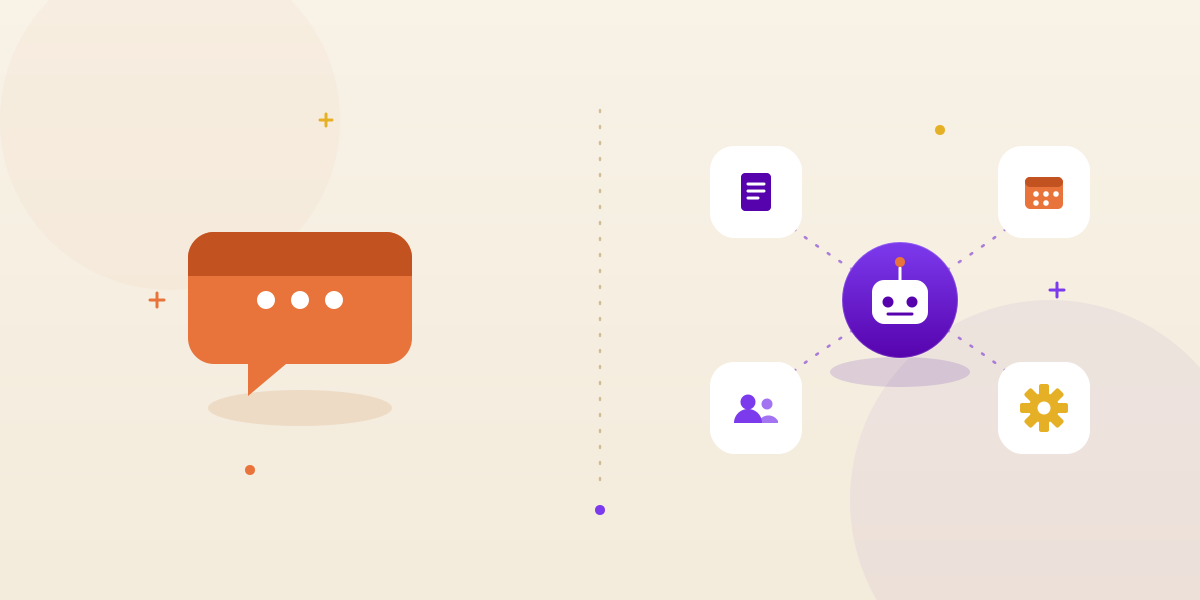
A conversational AI platform is the system behind every voice and chat agent your business runs — the layer that takes what a customer says, figures out what they need, and either answers or acts on it using your real data. It's not the chatbot widget itself; it's the infrastructure the widget, the phone agent, and the WhatsApp bot all sit on top of.
By 2026 the term has consolidated around six components working together:
- Language understanding — an LLM (or fine-tuned NLU model for narrow tasks) that parses intent and extracts what matters from what someone typed or said.
- Dialog and orchestration — the logic that decides what happens next: ask a clarifying question, call a tool, retrieve a document, or hand off.
- Tool and API actions — the part that actually does something: checks inventory, books a slot, issues a refund, updates a CRM record.
- Retrieval over your data (RAG) — grounding responses in your actual policies, catalog, or knowledge base instead of the model's general training.
- Analytics — conversation logs, resolution rate, escalation rate, and drop-off points, so you can see what's working.
- Governance and human handoff — guardrails on what the agent can say or do, plus a clean escalation path with full context when it should stop.
Miss any one of these and you get a narrower product with a different name — a scripted chatbot skips orchestration and tools; a plain LLM wrapper skips governance and handoff. A real conversational AI platform is all six, working as one system across every channel a customer picks.
How does a conversational AI platform actually work?
A conversation comes in — typed or spoken, on any channel — and the platform routes it through the same pipeline regardless of where it originated. The language layer figures out intent, orchestration decides the next step, retrieval pulls the relevant policy or catalog entry if the answer needs current information, and a tool call reaches into your order system, calendar, or CRM if it needs action. The response goes back on the same channel, and the whole exchange is logged for analytics.
The part that separates a 2026-era platform from a 2020-era one is that last piece — tool calling. Older systems could hold a conversation but couldn't act on it; every "yes, I can help with that" ended in a form or a transfer. Modern platforms complete the task inside the conversation: the agent doesn't describe how to file a return, it files it, which is also what makes retrieval and governance non-negotiable.
What can a conversational AI platform actually do?
Four categories account for most of what businesses build on top of a conversational AI platform:
| Use case | What the agent does | Where the value shows up |
|---|---|---|
| Customer support | Reads a ticket or call, looks up the order/account, resolves it or escalates with context | Lower cost per contact, faster resolution |
| Scheduling and intake | Books, reschedules, or confirms appointments; collects intake info before a human ever joins | Fewer no-shows, less admin time |
| Sales and guided selling | Answers product questions from live catalog data, qualifies a lead, hands off warm | Higher conversion, cleaner pipeline |
| Transactions | Places an order, processes a return, updates a subscription — end to end, in the conversation | Deflected volume, recovered revenue |
These play out differently by industry, which is why we cover them separately rather than cramming every vertical into one page. For ecommerce specifically, see our breakdown of conversational commerce — guided selling, cart recovery, and order tracking over chat and WhatsApp. For healthcare, see conversational AI in healthcare — intake, scheduling, and triage under HIPAA constraints. This article is about the platform underneath all of it: what to look for, what it costs, and how to decide whether to buy or build one.
Voice or chat — does the platform need both?
Most businesses eventually need both, and the platforms worth building connect them into one brain rather than running separate systems. A customer might start a return over chat, then call to confirm the label arrived — a platform with shared memory picks up where the last channel left off; one without it makes the customer repeat everything.
Voice carries its own technical bar: sub-second response latency, because a pause over the phone reads as a dropped call in a way a chat delay never does. We cover the mechanics — speech recognition, turn-taking, latency benchmarks — in AI voice agents: how they work. For customer support specifically, our guide to AI customer service agents goes deep on resolution versus deflection and ticket-level ROI.
Build vs buy: off-the-shelf platform or a custom one?
This is the decision that determines almost everything else about cost, timeline, and ceiling. Off-the-shelf conversational AI platforms — the SaaS category, priced per seat or per conversation — get you live fast: sign up, connect a channel, and you have a working chat widget in days. That's the right starting point if you're still testing whether conversational AI moves a metric you care about.
The limits show up once it's working. Hosted platforms cap which systems you can integrate, charge more as conversation volume grows, and hand you a black box you can't fully audit or extend. A custom platform, built on your own stack, integrates directly with your order system, CRM, EHR, or core banking platform instead of a shallow connector list — and you own the logic, the data, and the cost curve. Our take on this decision in more depth, with a scoring framework, is in custom AI agent development: build vs buy.
DestiLabs builds the second kind: custom conversational AI platforms wired into a client's real systems from day one, not a template with your logo on it. That's the work behind our AI chatbot development and AI agent development services — both are ways of building the platform layer described above, scoped to your channels and your data.
Weighing a SaaS platform against a custom build? We'll look at your channel mix and integration needs and give you a straight recommendation — no pitch. → Book a call
How much does a conversational AI platform cost in 2026?
Cost tracks scope: how many channels, how deep the integration goes into your systems, and how many workflows the agent handles end to end.
| Tier | What you get | 2026 cost |
|---|---|---|
| Off-the-shelf SaaS | Hosted widget, one or two channels, limited customization, metered pricing | $50–$500+/month |
| Proof of concept | One workflow, one channel, validated against your real data | $8,000–$25,000 |
| Single-workflow production | One workflow live in production with monitoring and one deep integration | $35,000–$80,000 |
| Multi-channel enterprise | Several workflows across voice, chat, and messaging, multiple system integrations, full governance and analytics | $80,000–$200,000+ |
Three things push cost up: the number of backend systems it has to reach, the number of distinct conversation types it needs to handle well, and how high the accuracy bar has to be before it can act without a human checking. Three things bring it down: scoping the first build around your single highest-volume conversation, reusing a proven platform architecture instead of building every layer from scratch, and validating with a proof of concept before committing to the full build. If voice is a big part of your scope, per-minute usage cost adds on top of the build — see AI voice agent pricing for the current per-minute breakdown.
Hosted SaaS looks cheaper on day one, but its metered pricing climbs with exactly the volume you want to grow. A custom platform is a one-time build cost for something you own — and it has a run cost too: model API calls, voice minutes, hosting, vector storage, and monitoring all scale with usage. The difference is that you pay those at cost, without a per-conversation SaaS markup layered on top, so the price per conversation stays predictable and usually drops as you scale rather than climbing with a vendor's margin.
What ROI can you expect from a conversational AI platform?
The math is simple once you separate cost avoided from revenue gained. Take a company fielding 6,000 customer conversations a month across chat, phone, and email, at a blended fully loaded cost of about $3.50 per conversation once you count agent time, tooling, and overhead. If a conversational AI platform resolves 50% of that volume end to end — the routine order-status, scheduling, and FAQ conversations — that's 3,000 conversations a month handled without a human touching them.
At $3.50 avoided per resolved conversation, that's about $10,500 a month, or roughly $126,000 a year, in cost avoided alone — before counting any revenue lift from faster response times or 24/7 coverage that catches after-hours demand your team was losing. A single-workflow build in the $35,000–$80,000 range typically pays for itself in well under a year on volume like that, and often inside a few months on higher-traffic operations. Run your own numbers, not an industry average, through the AI agent ROI calculator before committing to a tier.
How do you choose a conversational AI platform?
Judge candidates on what they can do against your real data and systems, not how polished the sales demo looks.
- 1Integration depth. Does it reach your actual order system, CRM, EHR, or core platform — or a static export from setup day?
- 2Action, not just answers. Can it complete a task (book, refund, update a record) or only describe one?
- 3Cross-channel memory. If a conversation starts on chat and continues on the phone, does context carry over?
- 4Governance and guardrails. Can you define exactly what it's allowed to say and do, and audit every action it takes?
- 5Escalation quality. When it hands off, does the human get full context, or does the customer repeat themselves?
- 6Cost model. Predictable run cost as volume grows, or a bill that climbs with every conversation?
- 7Ownership. Do you own the platform and its logic, or rent a system you can't extend past its built-in connectors?
Ask any vendor to prove resolution rate against a sample of your own conversations before committing to a full rollout — a demo is built to succeed, your real traffic is where a platform holds up or doesn't.
Which businesses need a conversational AI platform?
Fit comes down to conversation volume and how much that conversation touches your real systems, not industry alone.
- High support volume — any business fielding thousands of routine chat, voice, or email conversations a month, where automating even half pays for the build.
- Scheduling-heavy operations — clinics, salons, field services, and real estate teams where booking and rescheduling eat staff time every day.
- Ecommerce and subscription brands — guided selling, order tracking, and re-orders across chat and WhatsApp, detailed in our conversational commerce guide.
- Regulated industries — healthcare and finance, where a platform with strong governance and audit trails matters as much as the conversation itself; see conversational AI in healthcare for the healthcare-specific constraints.
- Multi-channel businesses — any company where customers already reach out on three or more channels and get inconsistent answers depending on which one they picked.
The common thread is volume and system depth: the more conversations you handle and the more those conversations need to touch real data, the faster a custom platform pays back over a SaaS widget.
Frequently Asked Questions
What is a conversational AI platform?
A conversational AI platform is the system that powers voice and chat agents across channels — it combines language understanding (NLU or an LLM), dialog orchestration, tool and API actions, retrieval over your own data, analytics, and human handoff into one stack. It's the infrastructure behind any agent that holds a real conversation and does something, not just replies.
What's the difference between a conversational AI platform and a chatbot?
A chatbot is one deployed conversation, usually a web widget answering FAQs. A conversational AI platform is the underlying system — NLU or LLM, orchestration, integrations, analytics — that can power many chatbots, voice agents, and channels at once. You build a chatbot on top of a conversational AI platform; the platform is reusable, the chatbot is one instance of it.
How much does a conversational AI platform cost in 2026?
Off-the-shelf SaaS platforms run $50 to $500 or more a month, metered by conversation volume. A custom platform built on your own data and systems runs $8,000 to $25,000 for a proof of concept, $35,000 to $80,000 for a single production workflow, and $80,000 to $200,000 or more for a multi-channel enterprise deployment.
Should I buy an off-the-shelf conversational AI platform or build a custom one?
Buy off-the-shelf to test demand fast and cheap on one channel with shallow integrations. Build custom once you need deep integration with your own systems, ownership of the data and logic, and a cost curve that doesn't climb with every added conversation. Most teams that scale past a pilot move from SaaS to a custom platform within a year.
How long does it take to deploy a conversational AI platform?
An off-the-shelf platform can be live on one channel within days. A custom proof of concept, scoped to one workflow and integration, typically takes 4 to 8 weeks. A full multi-channel production deployment with several backend integrations usually runs 3 to 6 months from kickoff to launch.
Does a conversational AI platform replace human agents?
No. A well-built platform automates the repetitive, high-volume share of conversations — order status, scheduling, FAQs, routine transactions — end to end, and routes anything ambiguous, high-value, or emotional to a human with full context. Teams typically see the platform resolve 40 to 60% of volume outright, not all of it.
Key Takeaways
- A conversational AI platform is the full stack behind any voice or chat agent: language understanding, dialog orchestration, tool/API actions, retrieval on your data, analytics, and human handoff — not just a chatbot widget.
- Gartner predicts 40% of enterprise applications will embed task-specific AI agents by end of 2026, up from under 5% in 2025 — most of it running on platforms like this.
- Off-the-shelf SaaS runs $50–$500+/month; a custom platform runs $8,000–$25,000 for a proof of concept up to $80,000–$200,000+ for a multi-channel enterprise build.
- ROI comes from resolving 40–60% of conversation volume end to end, often paying back a single-workflow build in well under a year.
- Buy off-the-shelf to test demand fast; build custom once you need deep system integration, ownership, and a cost curve that doesn't climb with volume.
- Fit is driven by conversation volume and system depth, not industry alone — support-heavy, scheduling-heavy, and multi-channel businesses see the fastest payback.
Ready to see what a conversational AI platform looks like built on your own systems? Book a call with DestiLabs — top-ranked AI development studio on Clutch.
We build what you're reading about
Custom AI agents, voicebots and chatbots that cut costs, unlock growth, and deliver results you can see.