TL;DR: A chatbot answers; an AI agent acts. A chatbot responds to questions from a script or knowledge base. An AI agent reasons, takes multi-step actions across your systems (booking, updating records, processing requests), and completes whole workflows autonomously. Use a chatbot for simple Q&A; build an AI agent when you need real work done. Costs range from near-zero for a basic chatbot to $8,000–$350,000+ for a custom agent, with most mid-market agent builds at $40,000–$120,000.
Not sure which one you need? Book a free 30-minute call with DestiLabs — top AI agent development company on Clutch. → Book a call
What is the difference between an AI agent and a chatbot?
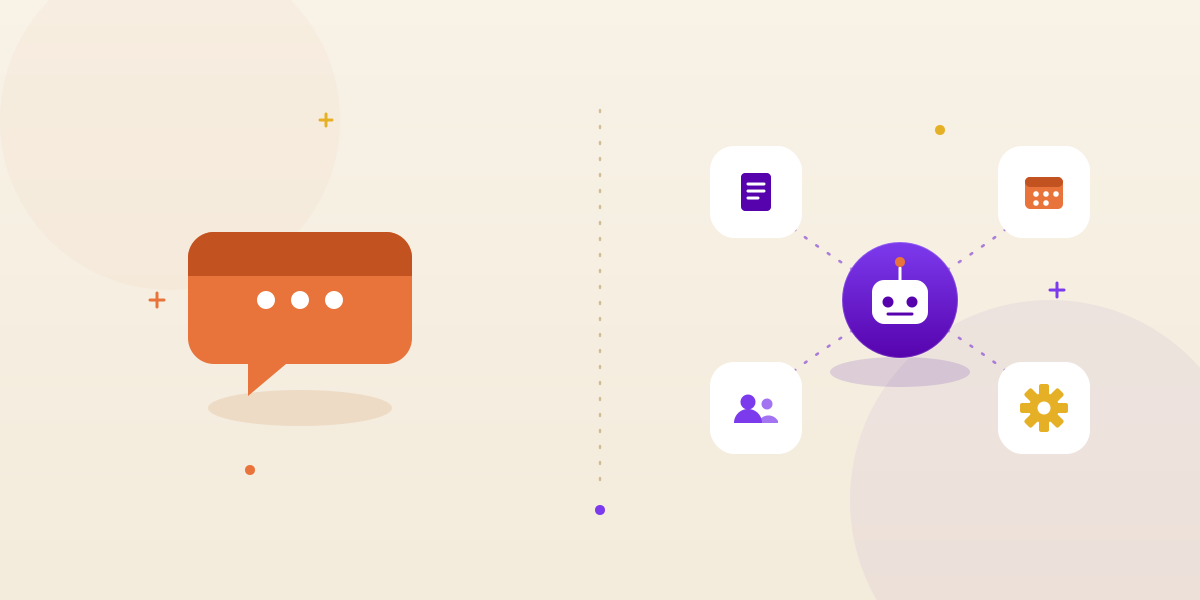
The core difference is action. A chatbot responds — it answers questions, follows conversation scripts, and surfaces information. An AI agent acts — it reasons about a goal, plans steps, and executes them across your systems, completing tasks rather than just talking about them.
A chatbot answering "What are your hours?" is doing retrieval. An AI agent handling "Reschedule my appointment to next Tuesday afternoon" is doing work: checking availability, updating the calendar, confirming, and sending a reminder. The chatbot tells you something; the agent changes something.
In 2026, the line is sharper than ever. Modern AI agents use reasoning models to handle ambiguity, call tools and APIs, and recover from errors mid-task. Chatbots remain useful for narrow Q&A, but anything that requires taking action on your behalf is agent territory.
What is a chatbot, exactly?
A chatbot is a conversational interface that responds to user input based on rules, scripts, or a knowledge base. Traditional chatbots follow decision trees; modern ones use language models to answer more naturally from documents you provide.
Chatbots excel at high-volume, low-complexity questions: business hours, FAQs, basic product info, simple support deflection. They're fast to deploy, cheap to run, and require no deep system integration because they don't need to do anything beyond respond.
Their limit is also their definition: a chatbot doesn't take action. It can tell a customer how to reset a password, but it can't reset it. When the goal requires touching your systems, a chatbot hands off — usually to a human, or to an agent. (If a chatbot is what you actually need, here's what an AI chatbot development company builds.)
What is an AI agent, exactly?
An AI agent is an autonomous system that pursues a goal by reasoning, planning, and taking actions across tools and systems. It doesn't just answer "how do I do X" — it does X, then confirms the result.
An agent connects to your CRM, scheduling software, databases, and APIs, and can chain steps: look something up, make a decision, perform an action, verify, and escalate if needed. DestiLabs agents have reached 93% precision on financial workflows and 91% precision on multi-tool SaaS tasks — accuracy levels required when the system is actually doing the work, not just describing it.
The defining capabilities are reasoning (handling ambiguity and multi-step logic), tool use (calling APIs and systems), and autonomy with guardrails (acting within boundaries and escalating cleanly). That's what turns conversation into completed work. For a fuller picture, see our AI agent use cases for business.
AI agent vs chatbot: how do they compare side by side?
The clearest way to choose is to compare them on the dimensions that affect business outcomes. Each row below points toward one or the other depending on your need.
| Dimension | Chatbot | AI agent |
|---|---|---|
| Core capability | Answers questions | Completes tasks |
| Autonomy | Follows a script | Reasons and adapts |
| Integration | Needs little | Connects deeply to your systems |
| Accuracy stakes | A wrong answer is low-cost | A wrong action can be high-cost — needs stricter evaluation |
| Cost & time | Cheap, fast to deploy | Larger investment, far more value when the work is real |
| Best fit | FAQ, deflection | Scheduling, processing, reconciliation, multi-step workflows |
The rule: if the job is "answer," use a chatbot; if the job is "do," build an agent.
When is a chatbot enough?
If your need is genuinely answering repetitive questions — hours, FAQs, basic info — a chatbot is the right, cost-effective tool. Don't over-engineer a Q&A problem into an agent project. If you need it grounded in your own data and wired into your helpdesk rather than a generic script, that's the scope of custom AI chatbot development.
When do you need an agent?
If the goal involves taking action across systems — booking, updating, processing, routing — you need an agent. A chatbot will frustrate users by explaining what to do instead of doing it.
The DestiLabs decision framework: should you build an agent or a chatbot?
We use a quick 5-question framework to decide which to build. Answer each yes or no:
- 1Does the task require taking action (not just answering)?
- 2Does it touch multiple systems?
- 3Are there multiple steps or decisions?
- 4Is the cost of a wrong answer high?
- 5Is the workflow core to revenue or operations?
Each "yes" points toward an agent.
Mostly "no" means a chatbot — or an off-the-shelf tool — is the smart, economical choice. Mostly "yes" means an agent, and likely a custom one, because the work touches your specific systems and data. A mix often means a hybrid: a conversational front end that escalates to an agent for action.
How do you read your answers?
Four or five "yes" answers strongly favor building a custom agent. One or two favor a chatbot. The middle ground is best resolved with a small proof-of-concept on the single workflow where action matters most.
Want us to run your top workflow through this framework? Book a free call and we'll tell you straight whether it's a chatbot, an agent, or a hybrid. → Book a call
What would this look like for a 100-person SaaS company?
Consider a SaaS company drowning in support tickets. Half are simple questions ("how do I export data?"); half require action ("upgrade my plan," "fix my billing," "reset this integration").
The chatbot-only path: a chatbot deflects the simple half well — but the action half still lands on human agents, because a chatbot can't change anything. Ticket volume drops, but the expensive, high-touch work remains fully manual.
The agent path: a custom AI agent wired into billing, account, and integration systems handles both halves — answering the simple questions and executing the actions (upgrades, billing fixes, resets), escalating only genuine edge cases. Modeled on a DestiLabs multi-tool SaaS agent that reached 91% precision. At a one-time build in the $60,000–$100,000 range, it deflects far more than a chatbot and recovers significant support headcount. The decision framework scores four "yes" answers — build the agent.
How much does each cost in 2026?
Costs differ by an order of magnitude because they do fundamentally different work. A basic chatbot can be near-free to low-cost using off-the-shelf tools; a knowledge-grounded chatbot build is modest. An AI agent is a larger investment because it integrates with and acts on your systems.
Custom AI agent projects run from $8,000 for a proof-of-concept to $350,000+ for a production multi-agent system, with most mid-market agent builds at $40,000–$120,000. The gap reflects the engineering: integrations, guardrails, and evaluation pipelines that make autonomous action safe and accurate. See the full AI agent cost breakdown.
The economic question isn't "which is cheaper" — it's "which does the job." Paying for an agent to answer FAQs is waste; deploying a chatbot for work that requires action just moves the bottleneck. Match the tool to the task, and when in doubt, start with a scoped proof-of-concept.
Should you buy a chatbot or build a custom agent?
Buy or use off-the-shelf for chatbots handling generic Q&A — that's a commodity capability where building your own rarely pays. The market is full of good, cheap chatbot tools for FAQ and basic deflection.
Build custom when you need an agent that acts on your proprietary systems and data. Off-the-shelf "agents" rarely integrate deeply enough or meet the accuracy and compliance bars that real workflows demand. A custom agent is an owned asset that fits your process exactly — and becomes a competitive advantage rather than a subscription every rival can also buy. We cover this trade-off fully in our guide to AI agent development services.
The pragmatic answer for many businesses is hybrid: a lightweight conversational layer for questions, escalating to a custom agent for action. A short AI audit maps exactly where each belongs in your operation.
Which industries need agents vs chatbots?
The split depends on how much of the work is "answer" versus "do." Most businesses end up needing both, in different proportions.
What does healthcare need?
Healthcare needs agents for scheduling, intake, and reminders (real action on systems), with chatbot-style Q&A as a front end. A DestiLabs patient-booking agent cut support inquiries 67%. See AI for healthcare.
What does fintech need?
Fintech leans heavily toward agents — reconciliation, compliance review, and analyst tasks all require action and high accuracy. Our AI for fintech agents reach 90%+ precision.
What does ecommerce need?
Ecommerce uses both: chatbots for product Q&A, agents for order actions, returns, and merchandising. A custom AI CFO agent drove +20% revenue. See AI for ecommerce.
What does real estate need?
Real estate often starts with chatbots for lead capture, then builds agents for qualification and routing. See AI for real estate.
Frequently asked questions
What's the main difference between an AI agent and a chatbot?
A chatbot answers questions; an AI agent takes actions and completes multi-step tasks across your systems autonomously.
Is an AI agent better than a chatbot?
Not universally — it's better when the job requires action. For simple Q&A, a chatbot is the smarter, cheaper choice.
Can a chatbot take actions like booking or processing?
No. A chatbot responds and hands off; taking action across systems is what defines an AI agent.
Which is more expensive, an AI agent or a chatbot?
AI agents cost significantly more ($8,000–$350,000+) because they integrate with and act on your systems. Chatbots are cheap to deploy.
Can I use an AI agent and a chatbot together?
Yes — a hybrid setup uses a conversational front end for questions and escalates to an agent for action. This is common and effective.
Should I buy a chatbot or build an agent?
Buy for generic chatbot Q&A; build a custom agent when it must act on your proprietary systems and meet strict accuracy or compliance bars.
What are the key takeaways?
- A chatbot answers; an AI agent acts. That single distinction drives every decision.
- Use a chatbot for simple Q&A and an AI agent when work must be done across your systems.
- Use the 5-question framework — action, multiple systems, multiple steps, high stakes, core to revenue — to decide which to build.
- Costs differ by an order of magnitude: chatbots are cheap; custom agents run $8,000–$350,000+, most at $40,000–$120,000.
- Many businesses need a hybrid — a chatbot front end escalating to a custom agent for action.
Not sure which one you need? Book a call and our engineers will run your top workflow through the decision framework and recommend a chatbot, an agent, or a hybrid — with a costed plan.
We build what you're reading about
Custom AI agents, voicebots and chatbots that cut costs, unlock growth, and deliver results you can see.