An AI chatbot development company builds custom AI chatbots — conversational systems that understand natural language, pull accurate answers from your knowledge base and systems, and complete tasks like booking, support, and lead qualification. Modern AI chatbots are nothing like the old button-based bots: they understand intent, remember context, take real action, and escalate intelligently. Expect a working prototype in about five days, production in a few weeks, and costs of roughly $8,000–$120,000+ for most chatbot builds depending on integrations and volume. Choose a company on shipped proof, answer accuracy (grounding), integration depth, and post-launch ownership — and judge cost against the support load it removes and the leads it captures.
Considering a custom AI chatbot? See our AI chatbot development services or book a free 30-minute call with DestiLabs — a top AI chatbot development company on Clutch. → Book a call
What Is an AI Chatbot Development Company?
An AI chatbot development company is a software firm that designs, builds, integrates, and maintains custom AI chatbots tailored to your business. Rather than handing you a configurable widget, it engineers a chatbot around your real content, your systems, and your support workflows — so the bot answers accurately and actually completes tasks instead of deflecting people to a form.
The reason this is a specialized service is that the hard parts are engineering parts: grounding answers in your real knowledge so the bot doesn't hallucinate, integrating with your systems so it can take action, and designing escalation so complex cases reach a human with context. A development company owns those parts. That's the difference between a chatbot that resolves conversations and one that frustrates customers into calling anyway.
What Does an AI Chatbot Development Company Build?
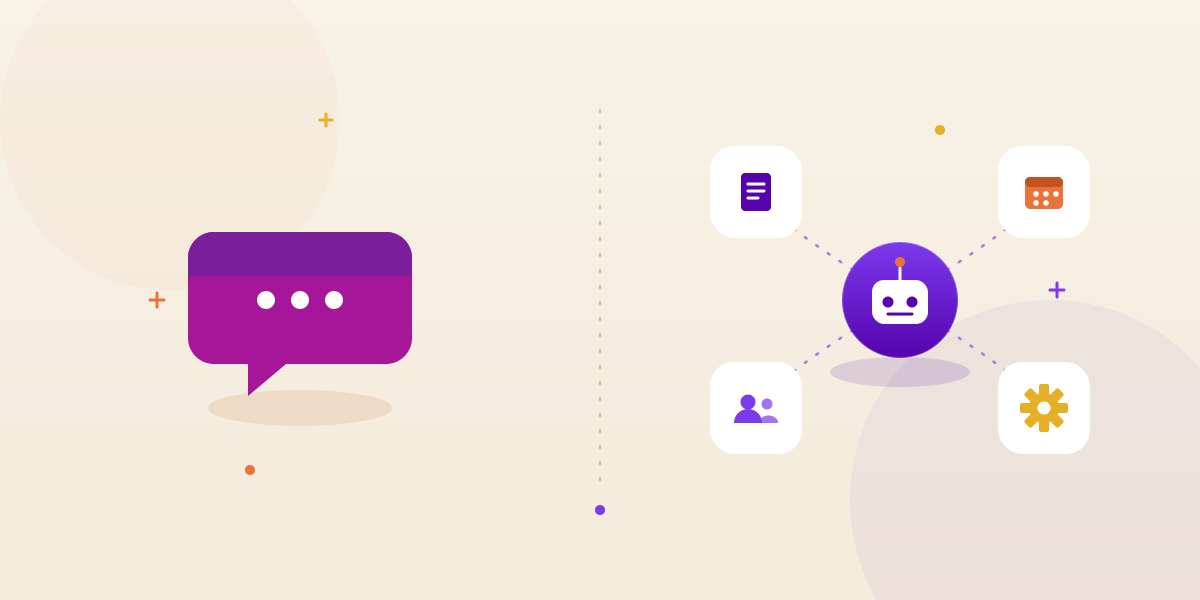
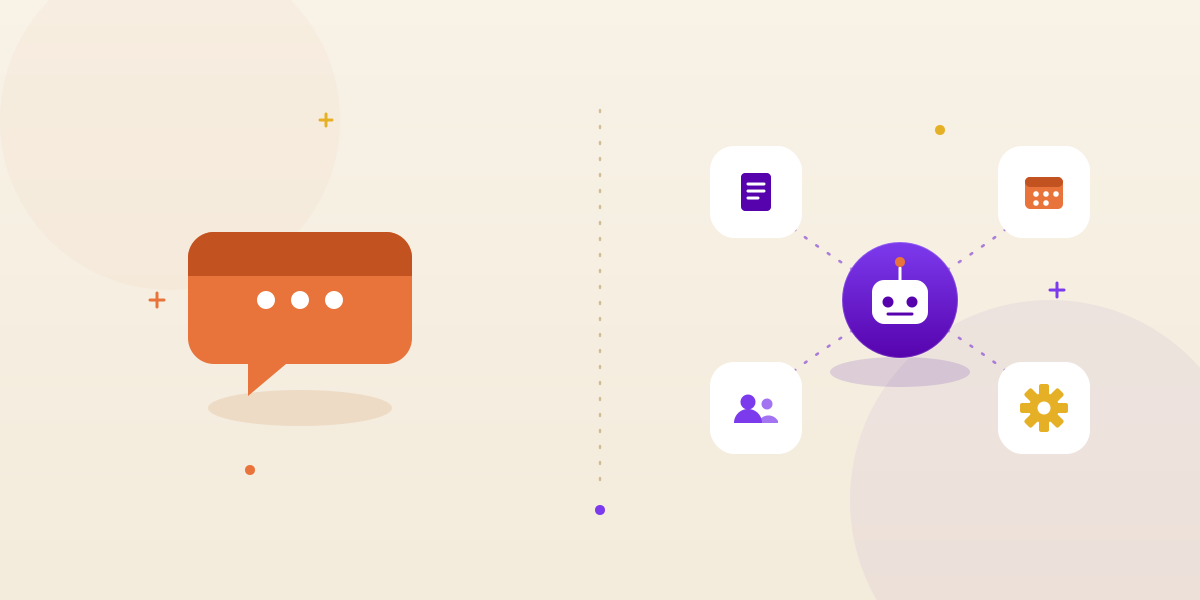
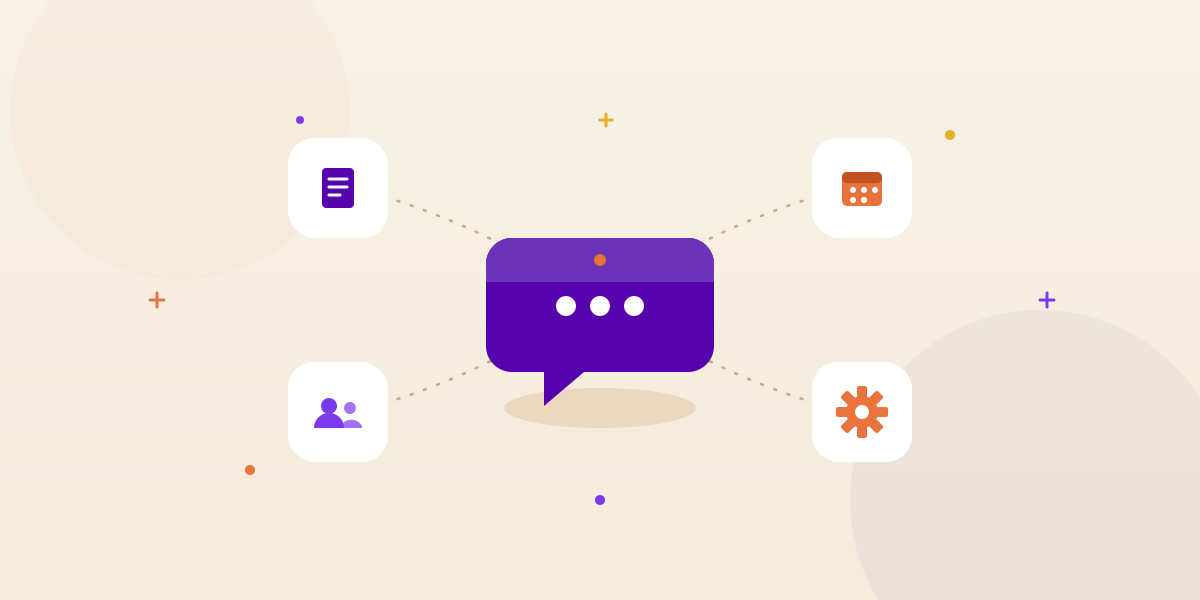
A real engagement produces an integrated system, not a script bolted onto your site, and it rests on three engineering layers. The first is a knowledge-grounded answer engine: the chatbot is connected to your real content — help docs, policies, product data — using retrieval so every answer is grounded in source material rather than invented. This is the single biggest factor in whether customers trust the bot. The second is system integrations that let it act, not just talk — connections to your CRM, order system, booking calendar, or internal APIs so it can check an order, book a slot, or update a record. Without this layer you have a fancier FAQ; with it you have something close to an agent, the same capability spectrum we cover in AI agent development services. The third is conversation design and escalation: flows that feel natural and resolve intent, plus a clean handoff that passes complex cases to a human with the full conversation context. Together these turn a chatbot from a deflection tool into a system that actually resolves conversations rather than containing them for their own sake.
How Are Modern AI Chatbots Different From Old Rule-Based Bots?
The old generation followed decision trees: tap a button, get a canned reply, hit a wall the moment your question didn't fit the script. They contained conversations but rarely resolved them.
Modern AI chatbots use large language models to understand free-form questions, retrieve accurate answers from your real content, and act in your systems. They handle the unexpected, remember what was said earlier in the chat, and know when to escalate. The shift is the same one happening in voice — see our explainer on what an AI voice agent is — where the same underlying engine powers natural phone conversations. In both channels, the leap is from scripted to genuinely conversational and action-capable.
| Capability | Old rule-based bot | Modern AI chatbot |
|---|---|---|
| Understanding | Fixed buttons and keywords | Free-form natural language |
| Answers | Canned, scripted replies | Grounded in your real content |
| Memory | None — each step is isolated | Remembers earlier in the chat |
| Action | Deflects to a form | Books, checks, updates in your systems |
| Escalation | Dead end | Hands off to a human with context |
What Can a Custom AI Chatbot Actually Do for Your Business?
The value shows up in three places: deflecting repetitive support, capturing and qualifying leads, and completing transactions.
On support, a grounded chatbot resolves the high-volume, repetitive questions that consume your team — and the impact is real. A healthcare booking assistant we built for Odycy cut support inquiries by 67% while serving patients 24/7. On lead capture, a chatbot greets website visitors, answers their questions, qualifies them, and routes hot prospects to sales instead of letting them bounce. On transactions, an integrated bot books appointments, checks order status, or processes simple requests end to end. Each of these maps directly to revenue or cost, which is why scoping the chatbot to one high-value job first is the smart move.
Where Do AI Chatbots Deliver the Most ROI by Industry?
A well-built chatbot is tuned to your sector's content, rules, and constraints, and the highest-return use case looks different in each one. In healthcare, chatbots handle intake, FAQs, and booking with HIPAA-compliant data handling and escalation for anything clinical — the Odycy assistant's 67% reduction in support inquiries is a healthcare-specific outcome (see AI for healthcare). In fintech, they answer account and product questions securely, with sensitive actions escalated and every interaction logged for auditability — the same precision discipline behind our financial-API agent's 93% accuracy (see AI for fintech). In e-commerce, chatbots guide shoppers, answer product questions, and recover carts, and the underlying intelligence can extend to revenue work, as with an AI CFO agent that drove +20% revenue and +16% AOV (see AI for ecommerce and our piece on AI shopping agents). In real estate, chatbots qualify and route inbound web leads instantly so none go cold while agents are out (see AI for real estate). The pattern holds across sectors: tune the bot to the content and rules that govern your industry, and start where the support or lead load is heaviest.
How Do You Choose an AI Chatbot Development Company?
Judge candidates on the fundamentals that actually predict success in production, not the polish of the sales demo. First, ask for shipped proof: production chatbots with real outcomes, not prototypes. Our case studies show the kind of evidence to expect — specific metrics, real clients, measurable impact. Second, ask how they prevent hallucinations; this is the make-or-break question. A serious company grounds answers in your real content with retrieval and can explain how it tests for accuracy. If they wave it away, the bot will invent answers and erode trust. Third, probe their integration depth, because a chatbot that can't reach your systems can't act — ask how they've connected bots to CRMs, booking systems, and internal APIs before. Fourth, check whether they prototype fast and own reliability: a company that ships a working prototype in days lets you validate before committing — DestiLabs ships one in the first five days — and one that owns monitoring and tuning after launch keeps the bot accurate as your content changes. A vendor who clears all four bars is far more likely to deliver a chatbot that resolves conversations than one who only demos well.
How Ready Is Your Business for a Chatbot? (The DestiLabs Readiness Scorecard)
Before scoping a build, score your own readiness 1–5 on five dimensions to see how big the project really is. The first is content readiness: is your knowledge — docs, policies, FAQs — organized and current? Clean content is the fuel; messy content means more work up front. The second is your integration surface: how many systems must the bot reach to be useful? One calendar is simple; five internal APIs is a bigger build. The third is volume and intent: how many conversations per month, and how transactional are they? High volume and transactional intent justify a richer build and pay back faster. The fourth is compliance load: regulated spaces like health and finance require specific data handling and audit trails, and that shapes the architecture from day one. The fifth is escalation maturity: do you have a clear human handoff for cases the bot shouldn't handle? A strong escalation path is part of a trustworthy chatbot, not an afterthought. Add up your scores — a total of 20+ means you're ready for an ambitious build; 12–19 means start with one workflow; below 12 means tidy your content and pick a single use case first.
How Much Does Custom AI Chatbot Development Cost?
Most custom chatbot builds land between roughly $8,000 and $120,000+, with the spread driven by the number of integrations, the depth of knowledge grounding, expected conversation volume, and compliance requirements.
| Chatbot scope | What it covers | Indicative build cost |
|---|---|---|
| Single-workflow FAQ bot | One use case, clean content, light integration | $8K–$20K |
| Support + booking bot | Grounded answers plus 1–2 system integrations | $20K–$50K |
| Multi-system / regulated bot | Many integrations, compliance, audit trails, high volume | $50K–$120K+ |
Ranges are indicative; running costs (LLM usage, hosting, monitoring) sit on top. A few factors push the cost up: multiple system integrations, strict compliance and audit needs, high volume — which raises both infrastructure and LLM usage — and complex multi-step transactions. The same levers in reverse keep it down: a focused single-workflow scope, clean existing content, a single integration target, and a phased rollout. The cheapest path to value is almost always one high-value workflow done well, then expanding from there once it's proven. The most useful way to frame the number isn't the build price in isolation but the support load the chatbot removes and the leads or sales it captures — that's where the payback comes from. For the full pricing logic and hidden costs like LLM usage and hosting, see our guide to how much it costs to build an AI agent.
What Does a Real Chatbot Build Look Like? (Worked Example)
Picture a service business handling 4,000 support conversations a month, most of them repetitive "where's my order," "what are your hours," and "how do I reschedule" questions. On the build side, discovery and content grounding take about a week, and a working prototype answering the top 20 question types lands by day five. Integration with the order system and booking calendar, plus accuracy testing and escalation design, takes a few more weeks. A build like this realistically runs around $14,000–$22,000, with modest monthly costs for LLM usage, hosting, and tuning. The payback is where it gets compelling: if the chatbot resolves even 60% of those 4,000 conversations — conservative given the Odycy result of 67% fewer inquiries — that's 2,400 conversations a month off your team's plate. At a few dollars of loaded support cost per handled conversation, the monthly savings alone can cover the running cost many times over, with the build cost recovered within a quarter. And that's before counting the leads captured and bookings completed that would otherwise have bounced.
How Long Does It Take to Build an AI Chatbot?
The pattern matches other agent work: a working prototype in about five days, a production-hardened chatbot in a few weeks. Knowledge grounding and integrations drive most of the timeline, not the conversational AI itself. Regulated or multi-system bots take longer, mostly for integration and compliance work. The staged approach — prototype, validate, then build fully — keeps you from investing months before you've confirmed the bot solves the right problem.
What Are the Red Flags When Hiring a Chatbot Company?
A few signs reliably predict trouble: a polished demo with no production references; vagueness about how they prevent hallucinations; no clear integration story; no plan for monitoring or keeping answers current as your content changes; and pressure to build everything at once instead of starting with one workflow. The green-light inverse is concrete references, a clear grounding-and-testing method, real integration experience, a support model, and a phased start.
Should You Build a Chatbot, a Voice Agent, or Both?
It depends on where your customers reach you. A chatbot owns typed website, app, and WhatsApp conversations; a voice agent owns phone calls. Many businesses run both, sharing one knowledge base and one set of integrations so answers stay consistent across channels. If most of your demand is typed and self-service, start with the chatbot; if most is by phone, start with voice and add chat later. The architecture a good development company builds makes adding the second channel far cheaper than the first.
Frequently Asked Questions
What is an AI chatbot development company?
It's a software firm that designs, builds, integrates, and maintains custom AI chatbots — conversational systems grounded in your content and connected to your systems that complete tasks like support, booking, and lead qualification.
How is a modern AI chatbot different from an old one?
Old bots followed rigid decision trees and canned replies. Modern AI chatbots use language models to understand free-form questions, retrieve accurate answers, take action in your systems, and escalate intelligently.
How do I choose an AI chatbot development company?
Look for shipped chatbots with proof, a clear method for grounding answers and preventing hallucinations, real integration experience, fast prototyping, and post-launch monitoring and tuning.
How much does custom AI chatbot development cost?
Most builds run roughly $8,000–$120,000+ depending on integrations, grounding depth, volume, and compliance. The best benchmark is the support load it removes and the leads or sales it captures.
How long does it take to build an AI chatbot?
A working prototype is realistic in about five days, with a production-hardened chatbot in a few weeks, depending on integrations and compliance.
Can a chatbot integrate with my CRM and knowledge base?
Yes. Integration with your knowledge base and systems is core to a real build and is what lets the chatbot answer accurately and take action rather than just chat.
Will a chatbot reduce my support volume?
A well-grounded chatbot typically deflects a large share of repetitive questions — a healthcare assistant we built cut support inquiries by 67% — freeing your team for complex, high-value cases.
Key Takeaways
An AI chatbot development company builds grounded, integrated, action-capable chatbots — not scripted widgets. Modern bots resolve conversations instead of deflecting them, and the biggest quality factor is how answers are grounded in your real content. Use a readiness scorecard to right-size the project, start with one high-value workflow, and judge cost against removed support load and captured leads. Expect a prototype in days, production in weeks, and most builds in the $8K–$120K+ range. Choose on shipped proof, accuracy method, integration depth, and post-launch ownership.
Ready to Build an AI Chatbot That Actually Resolves Conversations?
A modern AI chatbot understands, answers accurately, and completes tasks — turning your website and support channels into a system that resolves instead of deflects. DestiLabs is rated a top AI chatbot development company on Clutch, and we build custom AI chatbots grounded in your real content and wired into your systems, with results like 67% fewer support inquiries and 24/7 coverage. Book a free 30-minute call with our founders for an honest read on what your chatbot should do.
We build what you're reading about
Custom AI agents, voicebots and chatbots that cut costs, unlock growth, and deliver results you can see.