A generative AI development company designs and builds custom systems that create new content or answers — text, images, code, audio, structured data — using foundation models adapted to your business. Instead of selling a fixed product, it engineers a solution around your data, your workflows, and your guardrails. This guide explains what these teams actually build, what custom builds cost in 2026, and how to choose the right partner — including a 7-factor scorecard you can use on any vendor.
Need to build custom AI agents for your business? We're here to help you scale your business without scaling headcount. Book a call with DestiLabs — a top generative AI development company on Clutch. → Book a call
What is a generative AI development company?
A generative AI development company designs and builds systems that create new content or answers — text, images, code, audio, structured data — using foundation models adapted to your business. Instead of selling a fixed product, it engineers a solution around your data, your workflows, and your guardrails.
The work spans far more than wiring up a chatbot. It includes retrieval-augmented generation (RAG) so models answer from your knowledge base, fine-tuning and prompt engineering for accuracy, evaluation pipelines to measure quality, and integrations into the systems where work actually happens. The model is the easy part; the surrounding engineering is where results come from.
The distinction that matters in 2026 is custom vs. off-the-shelf. A generative AI development company builds an asset you own and control, grounded in your proprietary data — not a generic tool every competitor can also subscribe to.
What is generative AI development?
Generative AI development is the end-to-end engineering process of turning a foundation model into a working business system — not just calling an API, but grounding the model in your data, measuring its accuracy, and wiring it into the tools your team already uses. It's the discipline behind everything a generative AI development company ships.
In practice, generative AI development runs through a repeatable set of phases: discovery and use-case selection, data preparation, retrieval (RAG) or fine-tuning, prompt engineering, building an evaluation pipeline, integration, deployment, and ongoing monitoring. The generative model is one component; most of the generative AI development effort goes into the retrieval, evaluation, and integration layers that make output trustworthy on real data.
This is why generative AI development is an engineering exercise, not a prompting one. Teams that treat it as "pick a model and ship" produce demos; teams that treat it as software development — with testing, observability, and version control around the model — produce systems that hold up in production.
What does a generative AI development company actually build?
These teams build a recognizable set of solution types, each mapped to a business outcome. The common thread is grounding generative models in your data so output is accurate, safe, and useful.
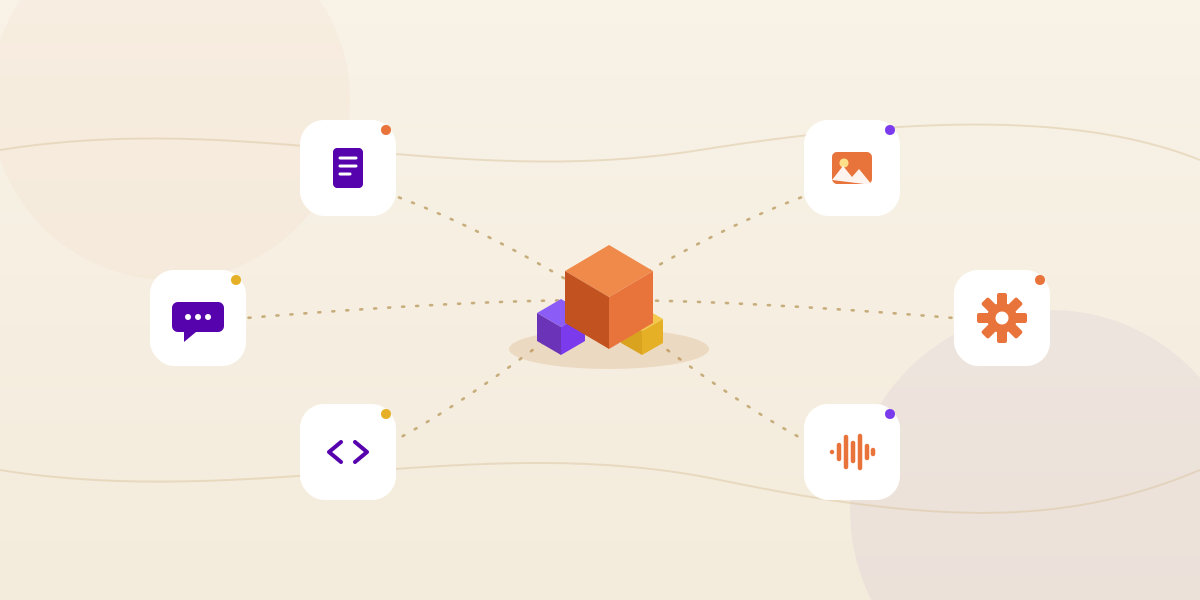
The most common builds are RAG knowledge assistants (answer from internal docs), document and report generators, customer-facing chat and voice agents, code and content copilots, and image/video generation pipelines for marketing and product. Increasingly, clients ask for multi-agent systems where specialized agents coordinate on complex workflows.
What ties these together is measurable ROI. In one DestiLabs generative imagery pipeline, per-asset cost dropped from roughly $300 to about $2.50. An AI video outreach system generated $500k in revenue and saved 400+ hours. Generative AI earns its keep when it's pointed at a real cost or revenue lever — not deployed for novelty.
What is a RAG knowledge agent?
RAG grounds a model in your documents so it answers from facts, not guesses — the single most reliable way to cut hallucination. Our financial-API agent reached 93% precision producing CFO-grade answers in ~5.5 minutes using this approach.
What are generative media pipelines?
For marketing and ecommerce, generative image and video pipelines collapse production cost and time. The $300→$2.50 per-asset shift above is typical of what a well-scoped pipeline delivers at volume.
What generative AI development services should you expect?
A full-service partner offers generative AI development services that span the whole lifecycle, not just the build. The strongest providers package their work into a clear menu so you can engage at the right depth for your stage — from a first audit to a production system under ongoing support.
Expect these generative AI development services on the table:
- AI strategy and audit — mapping which use cases are worth pursuing and which to skip. (See our AI audit.)
- Proof-of-concept development — validating a model on your real data before you commit to a full build. (See our proof-of-concept service.)
- RAG and knowledge-base implementation — grounding models in your documents so answers are accurate and cited.
- Fine-tuning and prompt engineering — adapting a model to your domain, tone, and tasks.
- Evaluation and quality pipelines — measuring precision, hallucination rate, and safety continuously.
- Generative media pipelines — image, video, and content generation at volume.
- Integration and deployment — wiring the system into your CRM, telephony, calendar, and internal APIs.
- Multi-agent orchestration — coordinating specialized agents on complex workflows.
- Post-launch support and tuning — keeping the system accurate as your data and usage change.
The difference between vendors isn't whether they list these generative AI development services — most do — but whether they can show evidence behind each one. A partner that can point to measured accuracy, named case studies, and a real integration track record is delivering services; one that only lists them is selling brochures.
How much does generative AI development cost in 2026?
Generative AI costs scale with scope, data complexity, and accuracy requirements. Published project ranges run from $8,000 for a focused proof-of-concept to $350,000+ for a production multi-agent platform, with most mid-market builds landing in the $40,000–$120,000 range.
A single-use-case generative tool — a RAG assistant over one knowledge base, or a document generator — typically lands in the $25,000–$60,000 range. Production systems with multiple data sources, evaluation pipelines, and human-in-the-loop guardrails sit around $60,000–$150,000. Multi-agent platforms push higher.
Beyond the build, budget for inference and operating costs. Well-engineered generative systems are cheap to run at the margin — our voice deployments operate at $0.12–$0.15 per minute — but architecture decisions made during development drive those numbers for years. For a full breakdown, see our AI agent development cost guide.
What drives generative AI cost up or down?
Cost rises with the number of data sources, strictness of accuracy and compliance requirements, and need for fine-tuning or multi-agent orchestration. Cost falls when you scope to one use case, reuse proven components, and validate with a proof-of-concept before scaling.
How do you choose a generative AI development company? The 7-factor scorecard
We give clients a 7-factor scorecard to evaluate any generative AI development company objectively, instead of being swayed by demos. Score each 1–5 and weight by what matters to your business.
The seven factors are: proven outcomes (real metrics, not slideware), evaluation rigor (do they measure accuracy systematically?), data security (how is your proprietary data handled?), integration depth (can they wire into your systems?), domain fit (have they worked in your industry?), model independence (are they tied to one vendor or pragmatic?), and post-launch support (who maintains it?).
The factor most teams underrate is evaluation rigor. Any vendor can show a slick demo; few can show how they measure and defend accuracy in production. A partner that talks fluently about evaluation pipelines, hallucination rates, and precision benchmarks is far more likely to ship something that holds up.
How do you use the scorecard?
Send the seven factors to two or three shortlisted vendors and ask for evidence on each. The strongest partners answer with numbers and named case studies; weaker ones answer with adjectives. If a vendor can't speak concretely about evaluation and data security, remove them.
What separates a great generative AI partner from an average one?
The best generative AI companies obsess over accuracy and evaluation, not model selection. Average teams pick a popular model and ship; strong teams build the retrieval, grounding, and evaluation layers that make output trustworthy on your real data.
Great partners are also model-pragmatic rather than model-loyal. They choose the right model for each task — sometimes a frontier model, sometimes a smaller cheaper one — and architect so you can swap models as the landscape shifts. That independence protects you from vendor lock-in and runaway inference bills.
Finally, the best partners think in outcomes. They start from your cost or revenue lever, scope to it, and measure against it. Third-party recognition is a useful signal here: DestiLabs is top-ranked on Clutch for Generative AI, AI Image Generation, and AI Text Generation — validation grounded in client-reported results, not self-assessment.
What does a real generative AI build look like? A worked example
Consider a professional-services firm whose consultants waste hours hunting through years of proposals, reports, and contracts to answer client questions. Generic chatbots can't help — the knowledge is proprietary and scattered.
The build: a RAG knowledge assistant grounded in the firm's document archive, with an evaluation pipeline measuring answer precision and citations back to source documents. Modeled on a comparable DestiLabs financial-API agent that hit 93% precision and produced expert-grade answers in ~5.5 minutes (down from hours of manual research).
The math: at a one-time build in the $55,000–$90,000 range, if 80 consultants each save 3 hours a week at a $90 blended rate, that's roughly $1.1M of recovered capacity annually — before counting faster client response times and higher win rates. The scorecard here points hard toward a custom build: high data sensitivity, deep integration, strict accuracy. A scoped proof-of-concept on one practice area retires the risk first.
How do you scope a generative AI project without overspending?
Start with one high-value use case and a short proof-of-concept. The most expensive generative AI mistake is funding a sprawling platform before proving the model performs on your real data and delivers measurable ROI.
Sequence the work: pick the single workflow with the clearest cost or revenue lever, run a 2–4 week proof-of-concept against real data, measure accuracy honestly, then expand only after the first use case earns its keep. A short AI audit up front maps which use cases are worth pursuing and which to skip.
Reuse proven components for everything non-differentiating — hosting, generic search, transcription — and concentrate custom engineering on grounding, evaluation, and integration. That's where generative quality is won or lost, and where your budget should go.
Which industries get the most from generative AI?
Generative AI delivers across sectors, but the highest-ROI use cases cluster where there's a lot of unstructured content or repetitive knowledge work.
How does healthcare use generative AI?
Healthcare uses generative AI for patient communication, intake automation, and clinical documentation — always inside compliance guardrails. A DestiLabs patient-booking agent cut support inquiries by 67% while running 24/7. See AI for healthcare and patient scheduling automation.
How does fintech use generative AI?
Fintech applies generative AI to report generation, compliance review, and analyst copilots. Our AI for fintech agents reach 90%+ precision on tasks generic tools can't safely attempt, and we've cut background-check review from over 48 hours to minutes.
How does ecommerce use generative AI?
Ecommerce uses generative AI for product content, merchandising, and shopper assistants. A custom AI CFO agent we built drove +20% revenue, +16% AOV, and −7% costs, and our generative imagery pipeline cut per-asset cost from ~$300 to ~$2.50. More in AI for ecommerce.
How does real estate use generative AI?
Real estate leans on generative AI for listing content, lead qualification, and document handling. See AI for real estate.
How do you keep generative AI accurate and safe?
Accuracy comes from grounding and evaluation, not from a bigger model. The most reliable defense against hallucination is RAG — forcing the model to answer from your verified documents and cite sources — combined with an evaluation pipeline that measures precision continuously.
Safety comes from controlling where data lives and what the model can do. A serious generative AI development company keeps proprietary data inside your environment, applies guardrails on what the system can generate and act on, and adds human-in-the-loop review for high-stakes outputs. This is non-negotiable in regulated sectors like healthcare and finance.
The teams that get this right treat evaluation as a first-class part of the build, not an afterthought. If a prospective partner can't explain how they'll measure and defend accuracy in production, that's the clearest signal to walk away.
Frequently asked questions
What does a generative AI development company do?
It builds custom systems on top of foundation models — RAG assistants, document and media generators, chat and voice agents — grounded in your data and integrated into your workflows.
What is generative AI development?
Generative AI development is the end-to-end process of turning a foundation model into a production business system — covering data preparation, RAG or fine-tuning, evaluation, integration, and monitoring. Most of the work is engineering around the model, not prompting it.
What generative AI development services do companies offer?
Common generative AI development services include AI strategy and audit, proof-of-concept development, RAG implementation, fine-tuning and prompt engineering, evaluation pipelines, generative media pipelines, integration, multi-agent orchestration, and post-launch support.
How much does a generative AI project cost?
From $8,000 for a proof-of-concept to $350,000+ for a production multi-agent platform. Most mid-market builds land at $40,000–$120,000.
How long does it take?
A proof-of-concept takes 2–4 weeks; a production single-use-case system typically takes 6–12 weeks depending on data and integration complexity.
What is RAG and why does it matter?
Retrieval-augmented generation grounds a model in your documents so it answers from facts and cites sources — the most reliable way to cut hallucination.
Will my proprietary data be safe?
With the right partner, yes. Your data stays inside your environment, guardrails control outputs, and high-stakes responses get human review.
How do I choose between vendors?
Score them on the 7 factors — proven outcomes, evaluation rigor, data security, integration depth, domain fit, model independence, and support — and demand evidence, not demos.
Key takeaways
- A generative AI development company builds custom, owned systems grounded in your data — not generic tools competitors can also buy.
- Accuracy comes from grounding (RAG) and evaluation rigor, not from picking a bigger model.
- Costs range $8,000 (PoC) to $350,000+ (production), with most mid-market builds at $40,000–$120,000.
- Use the 7-factor scorecard and demand evidence — proven outcomes and evaluation rigor separate great partners from average ones.
- Start with a scoped proof-of-concept on one high-value use case before scaling.
- DestiLabs is top-ranked on Clutch for Generative AI — recognition grounded in client-reported results.
Ready to scope a generative AI build? Book a call and our engineers will map your highest-ROI use case and give you a straight cost and timeline estimate. We help you scale your business without scaling headcount. → Book a call with DestiLabs
We build what you're reading about
Custom AI agents, voicebots and chatbots that cut costs, unlock growth, and deliver results you can see.